A woodland-animal theme can connect an autumn leaf-pressing activity, but decoration should never stand in for real plant information or safety guidance. Build the activity around verified collection rules and clear live text, then use the artwork to make each station easy to recognize.
Create one clear leaf-pressing system
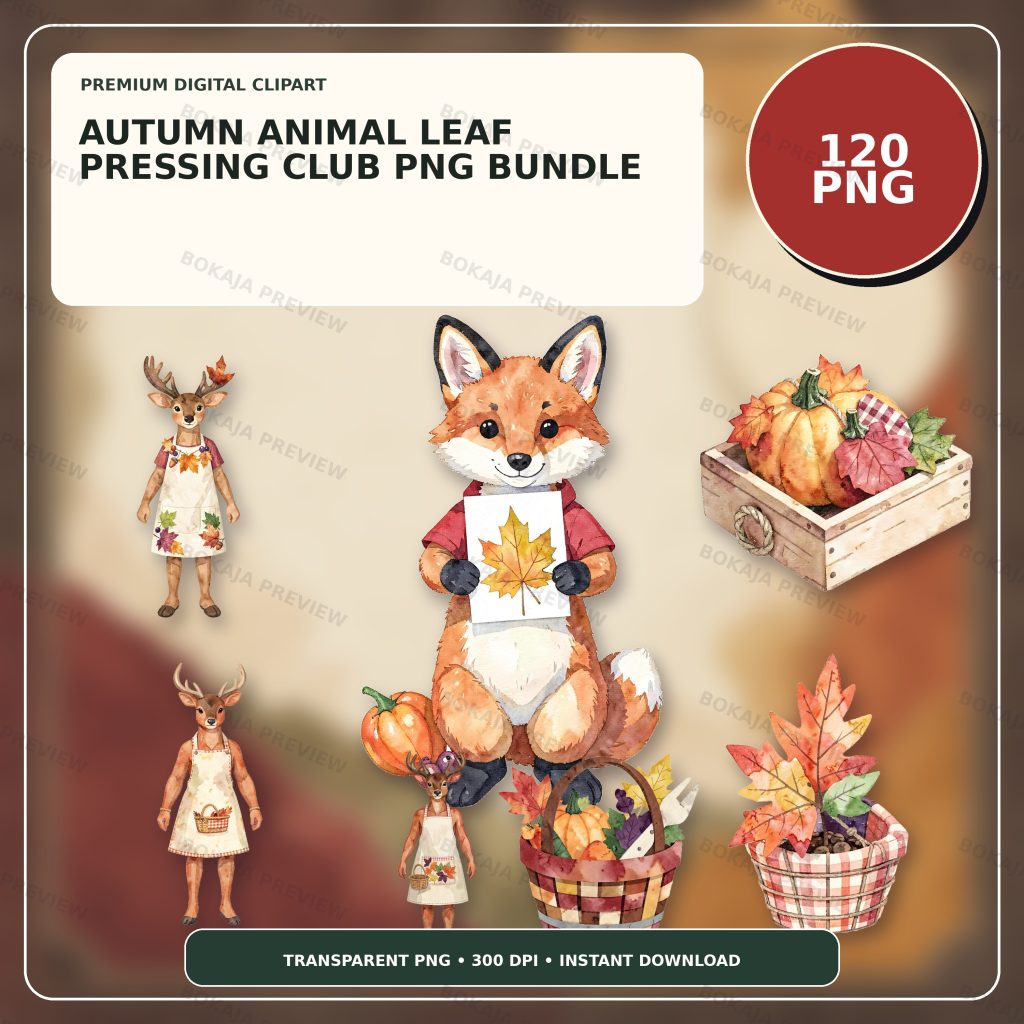
The Autumn Animal Leaf Pressing Club PNG Bundle is a live, purchasable digital product with 120 transparent PNG graphics at 3072 × 3072 px and 300 DPI metadata. Its original artwork centers on a fox holding a pressed maple-leaf card with coordinated autumn props. The files contain isolated complete silhouettes with no readable text, logo, known character, or full scene.
These PNG files are decorative source material. They are not editable nature-club templates, a plant-identification guide, a conservation rulebook, an allergy assessment, a lesson plan, or a safety certification. Add every collection instruction, specimen fact, warning, date, place, and participant field as live text in Canva or another suitable layout tool.
Choose one main fox or woodland animal for the welcome sign, two or three small leaf props for repeated markers, and one quiet border. Keep the real instructions beside the artwork rather than embedded in it. That preserves readable information and makes corrections possible when the organizer verifies the activity.
Leaf-pressing printable matrix
| Printable | Practical job | Useful fields | Adult verification |
|---|---|---|---|
| Welcome sign | Identify the activity and meeting point | Club name, time, route | Confirm permission, venue placement, and supervision |
| Collection card | Record where and when material was found | Date, broad location, collector code | Protect privacy and verify collecting rules |
| Specimen label | Keep one pressed item connected to its record | Verified name, date, place, notes | Do not guess species or safety |
| Observation prompt | Guide a factual visual description | Shape, edge, color, texture | Avoid tasting or unsupported claims |
| Supply-bin label | Name one approved material | Exact contents and handling note | Follow manufacturer and venue instructions |
| Take-home tag | Explain storage or next steps | Owner code, date, approved reminder | Verify drying, storage, and material guidance |
The matrix separates decoration from responsibility. A cute fox can identify the leaf station, but it cannot tell participants whether a plant is safe, protected, irritating, permitted to collect, or correctly named.
Confirm the collection rules first
Before designing cards, decide whether collecting is allowed at all. The responsible adult or venue must verify property permission, local conservation rules, protected species, seasonal restrictions, and rules for parks, school grounds, gardens, or nature reserves.
Prefer already fallen material when that is allowed and appropriate. Do not encourage pulling leaves, flowers, bark, seeds, or branches from living plants. Do not collect unknown, protected, irritating, poisonous, moldy, contaminated, or prohibited material. Never taste a plant to identify it.
Map the route, meeting point, boundaries, weather plan, supervision, accessibility needs, and hand-cleaning process. Keep participants away from traffic, water hazards, unstable ground, machinery, treated areas, and any location the organizer has not approved. A printable does not make an outdoor route safe.
Make collection cards factual and private
A useful collection card can record the date, a broad approved location, a collector code, weather notes, visible features, and a temporary specimen number. Use only fields needed for the activity.
Avoid putting a child's full name, home address, exact private location, live route, contact details, or school schedule on a public card or online sample. A group code or first-name initial may be enough when the organization allows it.
Keep observations literal: “five pointed lobes,” “smooth upper surface,” or “yellow edge” is different from claiming a species or safety property. If identification matters, use a suitable authoritative source or qualified person. The artwork and this article are not identification tools.
Keep specimen labels connected to records
Assign one temporary number to each allowed item and repeat it on the collection card, pressing sheet, and final label. This prevents loose leaves from being matched to invented details later.
A final label might contain a verified common name, scientific name where appropriate, date, broad location, and a short factual observation. Leave a field blank or mark it unverified rather than guessing. Do not describe a plant as edible, medicinal, pet-safe, child-safe, allergy-safe, or non-toxic without an appropriate reliable basis and permission to make that claim.
Use the woodland artwork in a corner and keep factual text in a plain high-contrast area. The classroom labels and teacher stickers tutorial explains how viewing distance and text load affect label size.
Write observation prompts that do not overreach
Prompts can ask participants to notice shape, edge, vein pattern, color, texture, size, and visible change after pressing. Do not ask participants to taste, rub, burn, crush, or deliberately smell unknown material. Avoid medical, environmental, or educational claims that the activity cannot prove.
Offer a suitable alternative for anyone who should not handle collected material. A photograph supplied by the organizer, a pre-approved clean sample, or a drawing exercise may fit better depending on the participant and venue. The responsible adult must decide what is appropriate.
Keep all prompts as live text so they can be enlarged, translated, simplified, or corrected. Decorative text baked into an image is harder to adapt and may not be accessible to every participant.
Label supplies literally
Name the actual approved contents of each bin: plain paper, blotting paper, cardboard, pencils, clips, or another verified item. Follow the material manufacturer's instructions and the venue's rules.
Traditional pressing methods may use heavy books, boards, straps, weights, or other equipment. The responsible adult must choose the method, control any heavy or pinching items, and verify drying, ventilation, storage, mold prevention, allergies, and fire or heat risks. This article does not prescribe a safety-certified pressing method.
Place a decorative fox or leaf beside the supply name, never in place of it. Do not label a bin “safe tools” or “allergy-free” unless the responsible organizer has verified the exact contents and is permitted to make that statement.
Prepare a low-ink and final-size proof
Autumn artwork can contain saturated oranges, reds, and browns. A low-ink option can use one main animal, a thin leaf border, generous white space, and dark text. Print one proof on the actual paper and printer.
Check the smallest type, writing space, contrast, crop marks, and whether details survive at final size. If pieces will be cut, test one sheet with the actual cutter, blade, mat, laminate, and software settings. The Canva vs Cricut tutorial explains the difference between layout and cutting workflows, while the PNG transparency guide helps catch unwanted backgrounds.
Leaf-pressing club production checklist
- ☐ Confirm property permission, local collecting rules, boundaries, and supervision.
- ☐ Identify protected, unknown, irritating, poisonous, or prohibited material to avoid.
- ☐ Do not encourage tasting, burning, crushing, or smelling unknown plants.
- ☐ Keep species, place, date, notes, warnings, and instructions editable.
- ☐ Use temporary specimen numbers to connect cards, press sheets, and labels.
- ☐ Protect participant names, exact private locations, and route information.
- ☐ Verify every tool and material against manufacturer and venue guidance.
- ☐ Review allergies, accessibility needs, age fit, weather, and alternatives.
- ☐ Keep heavy, sharp, hot, pinching, or controlled equipment with an adult.
- ☐ Use one main woodland animal and a small set of supporting leaf props.
- ☐ Print one sign, card, label, prompt, and tag at final size.
- ☐ Prepare a readable low-ink option where useful.
- ☐ Review the Bokaja digital product license before selling permitted finished physical items.
A soft product example
Product example: Use the fox holding a pressed leaf on the welcome sign, a small leaf prop on collection cards and specimen labels, and a quiet woodland detail on supply labels and take-home tags. The Autumn Animal Leaf Pressing Club PNG Bundle provides a coordinated visual library while the organizer keeps every instruction, specimen fact, date, place, warning, and participant field editable.
The product is digital; no physical signs, leaves, presses, labels, tools, cards, or nature-club supplies are shipped. Its attached order-download PDF contains the download link for the ZIP package. Read Digital Downloads and Refunds for current access and support information.
Related Bokaja tutorials
- Apple Orchard Classroom Printables
- Classroom Labels and Teacher Stickers
- Canva vs Cricut for Transparent PNG Files
- How to Use Canva for Beginners
- How to Check PNG Transparency and Quality
FAQ
Does the bundle include editable specimen-label or nature-club templates?
No. It contains transparent PNG graphics. Build signs, cards, labels, prompts, and tags in suitable layout software and add every fact, instruction, date, and warning as editable text.
Can the artwork identify a leaf or prove that a plant is safe?
No. Decorative artwork cannot identify a species or prove that a plant is edible, medicinal, non-toxic, allergy-safe, child-safe, pet-safe, or legal to collect. Use an appropriate reliable source or qualified person.
Is it always allowed to collect fallen leaves?
No. Permission and local rules vary by property, park, reserve, school, and region. The responsible adult or venue must verify what may be collected and where.
Can every participant use the same pressing method?
Do not assume so. Allergies, mobility, sensory needs, age, tools, materials, and venue policies vary. The organizer should provide suitable supervision and alternatives.
Can I sell finished leaf-club labels made with the graphics?
Review the digital product license first. Permitted finished physical items are different from reselling, sharing, extracting, uploading, or repackaging the original PNG or ZIP files.