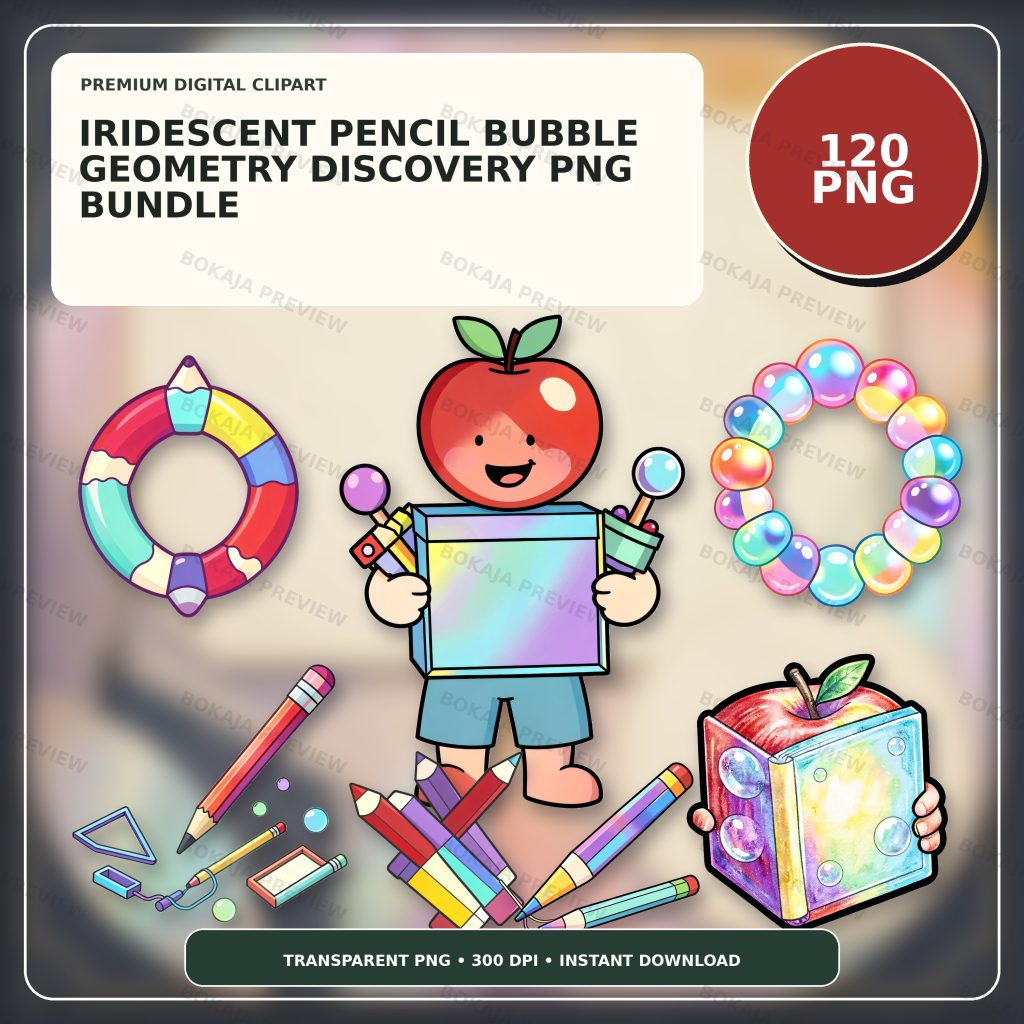
An apple teacher holding a cube-shaped bubble frame can connect shape prompt cards, observation sheets, vocabulary cards, station markers, prediction notes, and a closing checklist. The artwork is decorative: it does not make bubbles, measure an object, prove a geometry rule, provide laboratory equipment, assess a learner, or replace responsible-adult instruction. Confirm the real activity first, then keep every shape name, material, question, observation field, access choice, and safety instruction editable.
Build one coordinated geometry set
The Iridescent Pencil Bubble Geometry Discovery PNG Bundle is a live, purchasable digital product with 120 transparent PNG graphics at 3072 × 3072 px and 300 DPI metadata. Its original visual family centers on an apple teacher holding a cube-shaped bubble frame, with coordinated pencil, bubble, shape, and classroom accents.
The PNG files are visual source material. They are not bubble solution, frames, measuring tools, printed worksheets, lesson plans, scientific evidence, or curriculum approval. Add every practical fact in Canva, Cricut Design Space, or another suitable layout tool as live text so the responsible adult can correct a shape name, material, step, question, observation field, support route, or cleanup instruction.
Choose one main apple-and-frame graphic for the activity heading and two or three quieter pencil, bubble, or geometric accents for smaller pieces. A limited visual family keeps the six printables connected without letting iridescent effects compete with the real vocabulary, sequence, observation, and safety details.
Bubble geometry printable matrix
| Printable | Practical job | Editable facts | Responsible-adult check |
|---|---|---|---|
| Shape prompt card | Focus attention on one feature | Shape, question, example, response | Verify vocabulary and prompt |
| Observation sheet | Record what was actually noticed | Date, material, observation, drawing | Define an appropriate record |
| Vocabulary card | Display one approved term | Term, plain-language meaning, symbol | Match the real lesson source |
| Station marker | Identify one activity location | Station, materials, boundary, help | Check setup and supervision |
| Prediction note | Capture a testable idea | Prompt, prediction, reason, initials | Avoid presenting guesses as facts |
| Closing checklist | End and restore the station | Stop, count, clean, store, report | Confirm people and materials |
Each piece should do one job. Keep detailed experiment instructions, chemical or hygiene guidance, learner assessments, and school policy in their authoritative source. A decorative bubble, cube, pencil, line, or color effect cannot prove a mathematical property, demonstrate a safe method, establish that a frame is a true cube, or show that an activity suits every learner.
Confirm the real activity and vocabulary
“Bubble geometry” can describe a teacher demonstration, a discussion of two- and three-dimensional forms, a drawing exercise, or a supervised bubble-frame activity. Define the real format before writing any card. Decide which materials are approved, who handles them, which words the group already knows, how observations will be recorded, and what alternative participation looks like.
Collect the responsible adult, group, date, activity title, authoritative vocabulary, approved materials, exact sequence, observation method, stop signal, workspace boundary, cleanup process, accessibility arrangement, permission, supervision, and help contact. Use fictional names, dates, groups, and observations in public examples. If a real hands-on activity is planned, use the institution's current safety and hygiene guidance rather than extracting instructions from the clipart.
Do not infer from the graphics that the pictured frame has measured dimensions, that it will create a particular bubble surface, or that it is suitable classroom equipment. Keep claims modest: a card can prompt a discussion, organize a station, or provide space to write. It cannot certify understanding or guarantee a result. The Teacher Apple Seedling-Measurement Lab Printables guide uses the same separation between decorative graphics, editable observations, and adult-controlled activity facts.
Keep geometry prompts readable
Place the apple teacher beside the instruction rather than behind it. Use a plain, high-contrast typeface for shape terms, prompts, steps, boundaries, and help information. Decorative lettering can work for one short heading, but it should not carry a word or instruction a learner needs to interpret.
Pair every colored shape or bubble accent with a written label or approved tactile/verbal alternative so color is not the only source of meaning. Keep one prompt per card and one response area per observation block. Leave enough blank space for a drawing or short note without requiring tiny handwriting.
Protect privacy. Keep full learner names, assessment notes, support details, medical information, behavior records, and photographs off reusable public-facing materials. Avoid unsupported phrases such as “proves geometry,” “perfect for every learner,” “scientifically supported,” “safe experiment,” or “official curriculum.”
Make a final-size proof
Iridescent edges, faint bubbles, and thin shape lines can disappear on low-ink printers or merge into colored paper. Create a simplified classroom version with one small graphic, dark live text, and a plain background. Print one shape card, observation sheet, and station marker on the intended printer and material.
Check the smallest type, contrast, shape labels, sequence, response area, boundary, help route, cut lines, borders, and viewing distance. Ask the responsible adult to follow the set from arrival to cleanup without guessing. If using a cutter, test one sheet with the actual blade, mat, material, and current software settings. The PNG transparency and quality guide helps catch unwanted backgrounds and soft edges before producing a full set.
Geometry discovery checklist
- ☐ Confirm the responsible adult, group, activity, authoritative vocabulary, approved materials, and help route.
- ☐ Verify the real sequence, workspace, hygiene, cleanup, and safety rules with the appropriate authority.
- ☐ Keep shape names, prompts, observations, boundaries, alternatives, permissions, and supervision editable.
- ☐ Pair color and graphics with clear words, symbols, or another approved communication route.
- ☐ Use fictional data in public examples and protect learner names, assessments, health details, and support records.
- ☐ Avoid unsupported measurement, proof, safety, accessibility, curriculum, or learning-outcome claims.
- ☐ Print and test the prompt card, observation sheet, vocabulary card, station marker, prediction note, and checklist at final size.
- ☐ Review the Bokaja digital product license before selling permitted finished physical items.
A soft product example
Product example: Put the apple teacher and cube-shaped bubble frame on the main activity card, repeat smaller pencil or bubble elements on vocabulary cards and station markers, and keep the real geometry language visually quiet and easy to change. The Iridescent Pencil Bubble Geometry Discovery PNG Bundle supplies a coordinated visual library while the responsible adult controls every term, material, question, observation, boundary, permission, access choice, and safety decision.
The product is digital; no frame, bubble solution, card, worksheet, pencil, measuring tool, printer paper, or other physical item is shipped. After checkout, use the attached order-download PDF for package access. Read Digital Downloads and Refunds for current access and support details.
Related Bokaja tutorials
- Teacher Apple Seedling-Measurement Lab Printables
- Prism Light Science Classroom Printables
- Surface Tension Classroom Printables
- Classroom Labels and Teacher Stickers
- How to Check PNG Transparency and Quality
- Bokaja Digital Product License
FAQ
Does the bundle include a cube frame, bubble solution, or printed worksheets?
No. It contains transparent PNG graphics. Build the cards, sheets, and markers in suitable layout software, then source and approve every real material, instruction, and supervision arrangement separately.
Does the cube-frame graphic prove a geometry or bubble result?
No. Decorative artwork cannot measure a frame, create a bubble, prove a mathematical property, or predict an observation. Use authoritative lesson information and record only what participants actually observe.
Can these sheets be used as formal learner assessments?
Keep formal assessments and individual support records in the approved private system. A reusable observation sheet can provide writing space, but the responsible educator defines its purpose, rubric, privacy controls, and interpretation.
Can I sell finished classroom cards made with the graphics?
Review the digital product license first. Permitted finished physical products are different from reselling, sharing, uploading, extracting, or repackaging the original PNG or ZIP files.