A friendly fox and tiny sweater can give an autumn knitting table a warm visual identity, but the artwork should never replace the real pattern, measurements, fiber facts, or care information. Build the useful text first, keep it editable, and use the fox as a consistent decorative marker.
Start with one practical knitting-club system
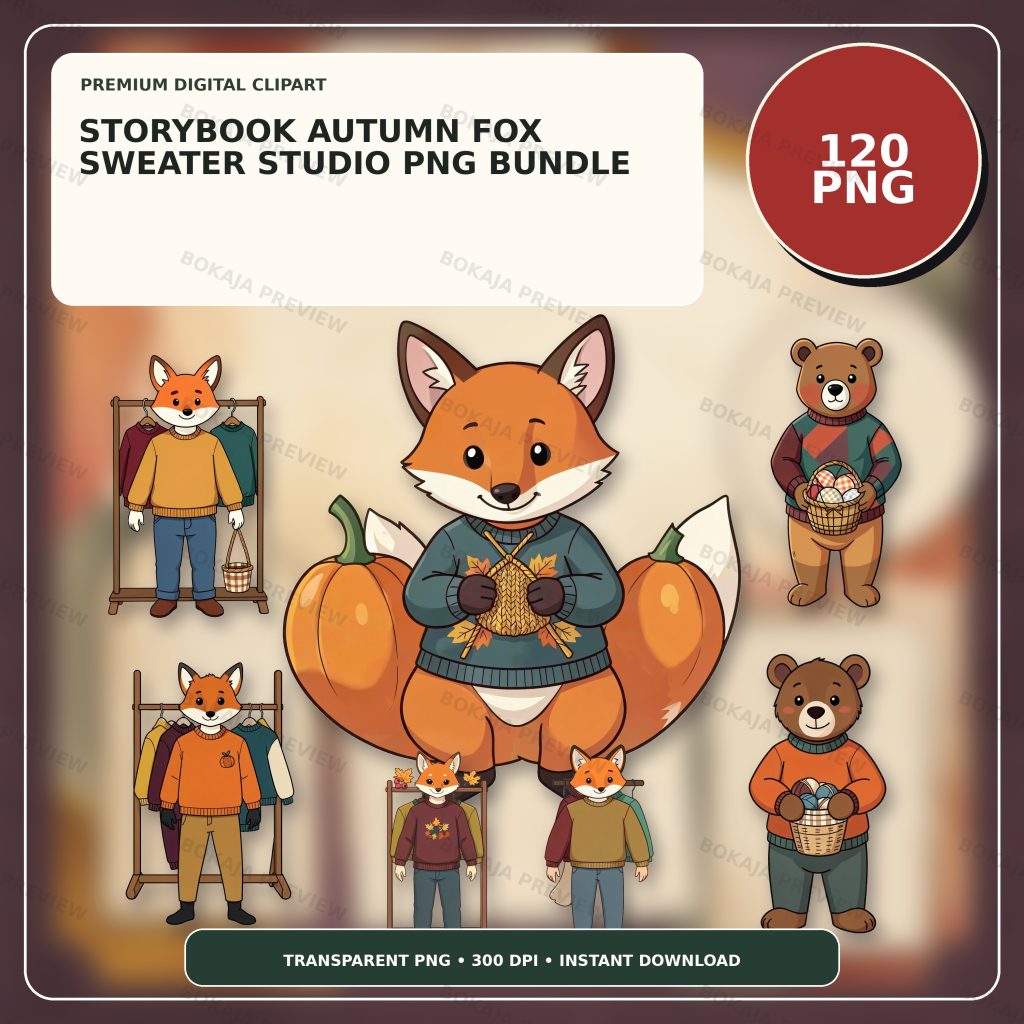
The Storybook Autumn Fox Sweater Studio PNG Bundle is a live, purchasable digital product with 120 transparent PNG graphics at 3072 × 3072 px and 300 DPI metadata. Its original artwork centers on a friendly fox knitting a tiny autumn sweater with coordinated cozy craft props. The files contain isolated complete silhouettes with no readable text, logo, known character, or full scene.
These PNG files are decorative source material. They are not knitting patterns, stitch charts, sizing instructions, fiber identification, tool guidance, product testing, care certification, or a promise that a finished garment will fit or last. Add every pattern name, size, material, tool, deadline, price, and care statement as live text in Canva, Cricut Design Space, or another suitable layout tool.
Choose one fox for the welcome sign, two or three small yarn or sweater props for repeated markers, and one quiet border. A limited visual set keeps the table coordinated without crowding the facts that makers and buyers need.
Knitting-club printable matrix
| Printable | Practical job | Best viewing distance | Maker verification |
|---|---|---|---|
| Welcome sign | Identify the club or craft table | Across a room | Confirm name, time, venue, and organizer |
| Project card | Track one work in progress | At a seat | Verify pattern, size, yarn, tools, and notes |
| Yarn-bin label | Identify an approved material group | One to two metres | Copy exact fiber, color, lot, and owner details |
| Gift tag | Identify maker and recipient | Handheld | Confirm names and avoid unsupported care claims |
| Market display card | Explain one finished item | At a stall | Verify price, materials, dimensions, and seller rules |
| Care-information card | Share factual handling details | Handheld | Use only verified maker or manufacturer guidance |
The matrix gives each piece one job. A welcome sign should not contain a full materials inventory, and a small gift tag should not carry a paragraph of care instructions. Move long or changeable information to a larger card.
Write project facts before adding artwork
Start with the pattern name, designer or source if relevant, intended size, actual measurements, yarn brand, fiber content, color, dye lot, needle or hook information, and the maker's own progress notes. Verify those facts against the real pattern, label, tool, and project.
Do not infer fiber content from appearance. Do not copy a care symbol, allergy statement, age rating, or safety claim without an appropriate source. If information is unknown, label it as unknown or leave the field open for the maker rather than guessing.
Place the fox beside a heading or in a quiet corner. Keep essential words off detailed fur, yarn, and sweater areas. The Canva for beginners tutorial shows how to keep text editable while arranging transparent PNG artwork.
Make project cards useful at the table
A project card can contain project name, start date, intended recipient, pattern reference, selected size, material, tools, current stage, and one next step. Include only fields the group will actually maintain.
For a shared club, use a first name, initials, or an organizer-approved code when full identity is unnecessary. Do not expose customer order details, private measurements, phone numbers, addresses, or other personal data in a public mockup.
Leave generous writing space and test it with the actual pen or pencil. If the card will be laminated, test the exact marker and cleaning method on one proof instead of claiming that all surfaces erase cleanly.
Label yarn and tools literally
A yarn-bin label should reflect the real contents: maker or owner code, yarn name, fiber content copied from the label, color, dye lot, weight category where verified, and quantity. Keep original packaging or manufacturer information available when it matters.
Do not label a bin “hypoallergenic,” “child-safe,” “non-toxic,” or “machine washable” without a reliable basis for the exact material. Keep needles, hooks, scissors, pins, blocking tools, and other sharp, hot, heavy, or controlled equipment managed according to the organizer's rules and manufacturer instructions.
The classroom labels and teacher stickers tutorial explains how viewing distance and text load affect label size, even when the labels are used in a craft room rather than a classroom.
Build honest gift and market cards
A gift tag can identify the maker, recipient, date, and a short verified note. A market display card can state the actual item, materials, dimensions, price, and permitted care information. Keep pricing and product facts editable so they can be corrected without rebuilding the artwork.
Do not claim that an item is handmade, organic, sustainable, washable, allergy-safe, one-of-a-kind, professionally tested, or suitable for a particular age unless the seller has a defensible basis. The responsible seller must verify local labeling, tax, consumer, venue, and product rules.
For small-shop use guidance, see Commercial-Use Clipart License Guide. A decorative fox can support a consistent look, but it does not prove a commercial claim.
Prepare a low-ink final-size proof
Warm autumn artwork may use saturated oranges, browns, and reds. A low-ink version can use one fox, a thin border, dark live text, and generous white space. Print one proof on the actual printer and stock.
Check the smallest type, writing area, contrast, folds, holes, crop lines, and whether reverse-side printing shows through. For cut tags or labels, test one sheet with the actual printer, paper, cutter, blade, mat, laminate, and software settings before batching. The PNG transparency and quality guide helps catch unwanted backgrounds and soft edges.
Knitting-club production checklist
- ☐ Confirm the club name, organizer, time, venue, and real project workflow.
- ☐ Verify pattern names, sizes, measurements, yarn, fiber, colors, and tools.
- ☐ Keep all maker facts, prices, care notes, and dates editable.
- ☐ Do not infer allergy, safety, washing, age, or durability claims.
- ☐ Keep customer names, measurements, contacts, and orders out of public samples.
- ☐ Use one main fox and a small set of coordinated sweater or yarn props.
- ☐ Keep essential wording away from detailed artwork, folds, and trim lines.
- ☐ Follow manufacturer and organizer guidance for tools and materials.
- ☐ Print one project card, label, gift tag, and display card at final size.
- ☐ Prepare a readable low-ink version where useful.
- ☐ Verify seller and venue rules before using a market display card.
- ☐ Review the Bokaja digital product license before selling permitted finished physical items.
A soft product example
Product example: Use the knitting fox on the welcome sign, a small yarn or sweater prop on project cards and bin labels, and one quiet autumn detail on gift and market cards. The Storybook Autumn Fox Sweater Studio PNG Bundle provides a coordinated visual library while the maker keeps every pattern, measurement, material, tool, price, and care fact editable.
The product is digital; no physical signs, sweaters, yarn, tools, cards, tags, or craft supplies are shipped. Its attached order-download PDF contains the download link for the ZIP package. Read Digital Downloads and Refunds for current access and support information.
Related Bokaja tutorials
- Commercial-Use Clipart License Guide
- Classroom Labels and Teacher Stickers
- How to Use Canva for Beginners
- Canva vs Cricut for Transparent PNG Files
- How to Check PNG Transparency and Quality
FAQ
Does the bundle include knitting patterns or editable project-card templates?
No. It contains transparent PNG graphics. Build cards, labels, signs, and tags in suitable layout software and add every pattern, measurement, material, tool, and instruction as editable text.
Can the artwork tell me which yarn or needle to use?
No. Follow the actual pattern, material label, manufacturer guidance, and the responsible maker's judgment. Decorative artwork is not technical knitting guidance.
Can I put real customer measurements on a public mockup?
Do not expose private measurements, names, contact details, addresses, or order information. Use fictional or generic sample data and follow applicable privacy rules.
Does a care card guarantee washing or durability results?
No. Use only verified guidance for the actual fiber, construction, and finished item. Materials, tools, techniques, and use conditions vary.
Can I sell finished project cards or gift tags made with the graphics?
Review the digital product license first. Permitted finished physical items are different from reselling, sharing, extracting, uploading, or repackaging the original PNG or ZIP files.