A commercial-use clipart licence tells you which uses the creator permits; the phrase “commercial use” by itself is not a complete set of rules. Read the actual licence for the specific product and planned deliverable before selling anything.
Choose Watercolor Christmas Robin Gift-Wrapping Studio for a physical greeting-card example, or Rainbow Crayon Art Studio for a physical sticker example. Both are paid PNG artwork collections for layouts you design yourself; add your own text, shapes and measurements.
Make it with these Bokaja sets
Choose the style that fits your project. These are digital PNG artwork collections: add your own text and build the layout shown in this guide.

Watercolor Christmas Robin Gift-Wrapping Studio
Gift-wrapping artwork for a physical greeting-card example.
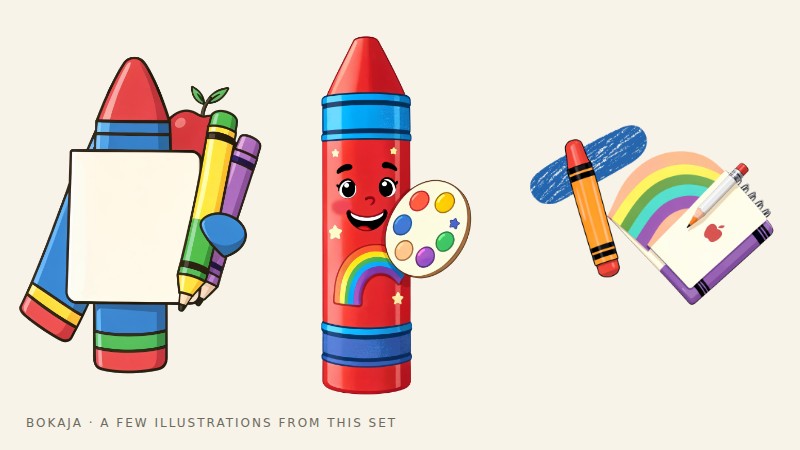
Rainbow Crayon Art Studio
Classroom artwork for a physical sticker example.
Worked example: the same illustration in three different offers

Suppose you use a gift-wrapping PNG to design a 5 × 7-inch greeting card. The artwork is identical in the following offers, but the customer’s access and the production route differ.
| Proposed offer | What needs checking |
|---|---|
| You print and sell the finished physical card | Confirm the product’s small-business physical-end-product permission and any applicable limits |
| You sell an editable card template | Check explicit digital-template permission and whether the original art can be extracted |
| A third-party service prints and ships the card | Check both the artwork licence and the provider’s upload/use terms for that arrangement |
The linked product listings describe personal use and small-business commercial use on finished physical products, while prohibiting redistribution or repackaging of the source PNGs as digital assets. That makes a reader-designed physical card a different proposal from offering the PNG in a downloadable template. Do not treat flattening as a magic permission switch; the actual permitted deliverable still matters.
Write a one-paragraph use record before preparing a sales listing: “I will print this design on cards in my shop. Customers receive only the physical cards. The source PNG remains in my private project archive.” Add the exact product URL, purchase record and applicable licence copy.
If your plan instead involves a digital download or outside production service, describe that explicitly when asking for clarification. Include whether the customer can edit the file, whether the provider stores the art for reuse, and what files leave your control. A precise description is much easier to resolve than “Can I use this commercially?”
Use the classroom-art collection for the same exercise with physical stickers. The object changes, but the decision process stays the same: identify the deliverable, identify who receives files, then match the actual use to the terms before listing it.
Define what you intend to sell
Write a concrete description: “printed greeting cards made in my small shop,” “an editable invitation template,” or “a pack of downloadable PNG stickers.” These are different uses even if they contain the same illustration.
Also identify who receives which files. A customer buying a physical card receives the finished object. A customer receiving an editable template may be able to extract or reuse the original artwork. A production supplier may need a file to manufacture an item, which raises its own licence questions.
Specificity makes the licence easier to interpret and gives the seller a useful question if you need clarification.
Read the applicable source, not a summary alone
Check the product page, the linked licence and any README supplied with the download. Note whether the product has an exception or a separate licence tier.
At Bokaja, the Digital Product License is the public starting point for purchases made directly from the shop unless a product page says otherwise. The public terms describe permission for personal projects and small-business physical end-products such as printed stickers, shirts, mugs, cards and party decorations.
It also describes permitted client work where the final deliverable is a physical or finished design rather than the original source files. That wording should not be stretched into blanket permission for every editable digital product or third-party service.
Understand the prohibited redistribution
The Bokaja terms prohibit reselling, sharing, gifting, redistributing, uploading or repackaging the original PNG, ZIP or source files. They also prohibit uploading files to marketplaces, print-on-demand asset libraries, stock sites or design-resource bundles as digital assets.
Adding a border, changing a color or placing several images in one folder does not automatically turn prohibited source redistribution into an allowed new product. The relevant question is what the licence permits and what the recipient can actually obtain.
Do not offer the original artwork as a bonus download with a physical purchase unless the applicable licence explicitly allows it.
Check digital products separately
An editable template, downloadable classroom resource or digital sticker pack is not the same thing as a printed physical item. Do not assume that permission to sell the latter covers the former.
If the intended use is unclear, ask the seller before purchase or release. Include the exact product URL, the finished format, whether the customer can edit it, and how the artwork will be protected from extraction or reuse.
A useful question is: “May I sell a flattened PDF of this specific project, and are there any conditions?” A vague question such as “Is this commercial?” may leave the important distinction unresolved.
Consider production providers and other rights
Print-on-demand involves both an end-product and a service receiving production files. Confirm that your specific arrangement is permitted, especially if a platform’s terms grant broad rights over uploads or place assets into a reusable library.
A clipart licence also does not automatically grant trademark, brand or personality rights. The current Bokaja licence explicitly excludes trademark and brand rights and does not permit implying endorsement by protected parties.
Avoid using an image or phrase in a way that suggests an official branded product merely because the artwork file was legitimately purchased.
Keep evidence with the project
Save the order receipt, product URL, downloaded README and a dated copy or record of the applicable licence. If the seller gives clarification, keep that response with the project documentation.
Use a folder structure that separates original source files from customer deliverables. Before exporting or packaging an order, check that the source folder is not accidentally included.
For a team, share access only in a way allowed by the licence. A shared drive is still a form of file access; it is not automatically exempt from licence restrictions.
Your next step
Keep the use decision and applicable terms with the project. If the customer deliverable or production route changes, revisit permission before reusing the same commercial listing.
Start with Watercolor Christmas Robin Gift-Wrapping Studio, or choose Rainbow Crayon Art Studio for the alternative theme described above. These collections supply PNG illustrations for your own layout; the project text and construction remain yours.