Autumn leaves, walnut-shell boats, and woodland characters can inspire a memorable maker activity, but attractive artwork is only the starting point. A useful printable set also needs clear roles, editable instructions, readable labels, and a plan for adult supervision.
Choose the printable by the job it must do
Start with the practical job, not the decoration. A team label needs to be recognized from several steps away. An observation sheet needs room for handwriting. A route marker needs one short instruction and strong contrast. Keeping those jobs separate makes the set easier to use in a classroom, homeschool group, autumn club, or supervised family craft session.
| Printable piece | Practical job | Keep editable | Final proof |
|---|---|---|---|
| Entry card | Records a fictional team or boat name | Name, group, date, permission note | Text is readable at arm's length |
| Boat-design note | Organizes a drawing or material plan | Materials, dimensions, assembly notes | Adult confirms the real materials |
| Route marker | Shows an approved start, turn, or finish point | Location, arrow, boundary wording | Marker matches the actual supervised area |
| Observation sheet | Captures what participants notice | Prompt, time, conditions, result field | Writing spaces work at printed size |
| Team label | Identifies a tray, table, or group | Team name, color cue, accessibility cue | Label remains clear without color alone |
| Closing checklist | Guides a calm finish | Return, count, dry, recycle, cleanup steps | Responsible adult approves every step |
The decorative mouse, walnut shell, leaf sail, flag, and water motifs do not prove that a model will float or steer. They also do not predict weather, measure performance, approve a location, provide materials, or make an activity safe. Put real instructions in live text that can be reviewed and changed.
Build the set in Canva
Canva works well when the main job is arranging cards, labels, and worksheets on a page. Create the document at the intended paper size, add guides for margins, and place each transparent PNG inside a reserved illustration area. Keep instructions in separate text boxes so names, boundaries, material lists, and accessibility notes can be edited without changing the artwork.
Use one heading style, one body style, and a small set of high-contrast colors. Avoid placing important words over detailed leaves or textured water. If a card will be cut out, leave enough quiet space around both the wording and the illustration. Print one draft at 100% scale before duplicating the layout across a full set.
For a broader tool comparison, use the Bokaja guide to transparent PNG clipart in Canva vs Cricut. It explains why page layout and cutting workflows should be treated as separate production stages.
Prepare pieces for Cricut
Cricut can help with contour-cut labels, team markers, or decorative pieces after the page content is settled. Export only the piece you intend to cut, preserve the transparent background, and inspect the edge at high zoom before upload. Fine leaf stems, whiskers, or tiny sail details may be too delicate at a small final size, so simplify the cut shape or add a deliberate border when needed.
Do not assume that a clean screen preview guarantees a clean physical cut. Material, blade condition, printer alignment, lighting, and machine settings all affect the result. Use a small test piece first, follow the current instructions for your own equipment, and keep cutting tools under responsible-adult control.
The PNG transparency and quality checklist can help catch white boxes, rough halos, accidental cropping, and soft edges before a full sheet is printed.
Plan a dry-table activity before any water test
A regatta theme does not require real water. The same pieces can support a dry tabletop design challenge, a fictional route-mapping activity, a story prompt, or a display board. This is often the simplest option when space, accessibility, cleanup, or supervision is limited.
If a responsible adult chooses a real model-boat activity, they should define the materials, water container or approved location, boundaries, retrieval method, weather rule, hygiene plan, and cleanup process. The printable should record those decisions; it should never invent them. Use fictional observations in a template example so participants are not led to copy a result they did not observe.
For related autumn planning ideas, compare the Autumn Animal Leaf-Pressing Club Printables, Corn Maze Compass Club Harvest Printables, and Fall Raccoon Maple-Syrup Market Printables. Each guide uses a different practical structure, which helps avoid turning every seasonal activity into the same worksheet.
Print and usability checklist
- ☐ Confirm the paper size, printer scaling, margins, and orientation.
- ☐ Keep names, routes, materials, results, and safety wording as editable text.
- ☐ Check that every instruction remains readable without relying on color alone.
- ☐ Print one page at 100% and inspect it under the lighting where it will be used.
- ☐ Test one cut before producing a full Cricut sheet.
- ☐ Remove decorative details that become fragile or unclear at final size.
- ☐ Use fictional sample data rather than implying a measured outcome.
- ☐ Ask a responsible adult to approve materials, boundaries, weather rules, accessibility, privacy, and supervision.
- ☐ Include a return-and-cleanup step that fits the actual setting.
Product example: Walnut Mouse Leaf Sail Regatta PNG Bundle
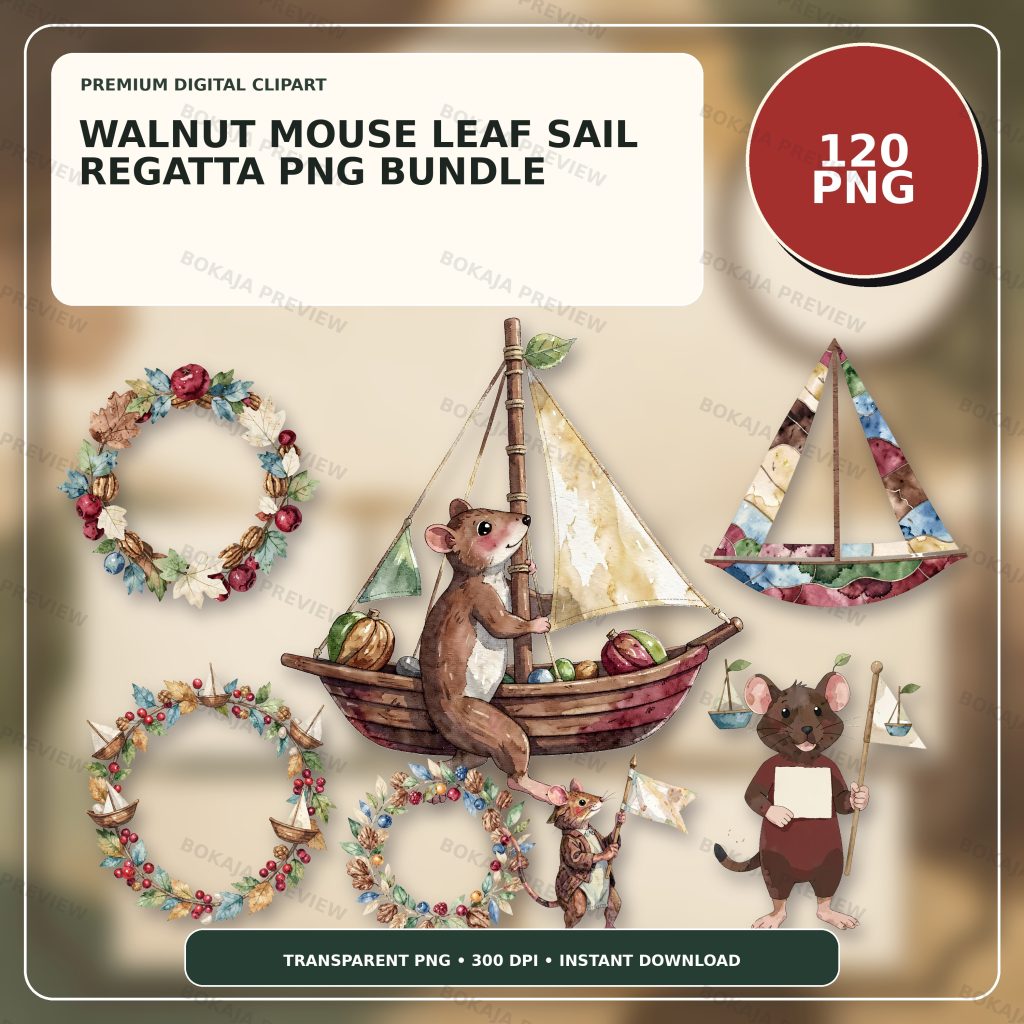
The Walnut Mouse Leaf Sail Regatta PNG Bundle is a soft visual example for this workflow. The live product includes 120 transparent PNG graphics, 3072 × 3072 px artwork, and 300 DPI metadata. It is published, visible, in stock, and priced at €3.00. One order-download PDF is attached to the product and provides access instructions for the ZIP package; no physical boat, shell, sail, leaf, craft material, or printed card is shipped.
The high-resolution square artwork gives room for layout experiments, but final print quality still depends on the chosen size, printer, paper, and production method. Always inspect a proof instead of treating DPI metadata as a guarantee.
Personal and small-business commercial use applies to permitted finished physical products, while the source PNG and ZIP files may not be resold, shared, uploaded, extracted, redistributed, or repackaged as digital assets. Review the current Digital Product License before selling or sharing a finished project, and read Digital Downloads and Refunds for delivery and support details.
Related Bokaja tutorials
- Transparent PNG Clipart for Canva vs Cricut — choose the right layout and cutting workflow.
- How to Check PNG Clipart for Transparency and Quality — inspect edges, backgrounds, and export quality.
- Best PNG Size and DPI for Print-on-Demand — understand pixels, print size, and proofing limits.
- Autumn Animal Leaf-Pressing Club Printables — compare another leaf-based autumn planning system.
FAQ
Do the PNG graphics include editable instructions?
No. The artwork is decorative. Add names, materials, route rules, observation prompts, permissions, and safety instructions as editable text in your own layout so the responsible person can verify them.
Can I make these printables in Canva and cut pieces with Cricut?
Yes. Canva can handle the page layout and editable wording, while Cricut can be used for selected contour-cut pieces. Export carefully, preserve transparency, inspect the edges, and test at the real final size.
Does 300 DPI metadata guarantee a sharp print?
No. DPI metadata is one part of the file information. Sharpness also depends on pixel dimensions, final print size, printer, paper, scaling, and production settings. A 100% physical proof is the reliable check.
Can I sell finished items made with the bundle?
The current Bokaja license permits specified personal and small-business uses for finished physical products, but it does not permit redistribution of the source PNG or ZIP files. Check the live license before starting a commercial project.
Is this a real boat-building or water-safety guide?
No. It is a printable planning workflow using decorative artwork. A responsible adult must choose and approve any real materials, location, boundaries, weather rule, retrieval method, accessibility arrangement, and supervision plan.