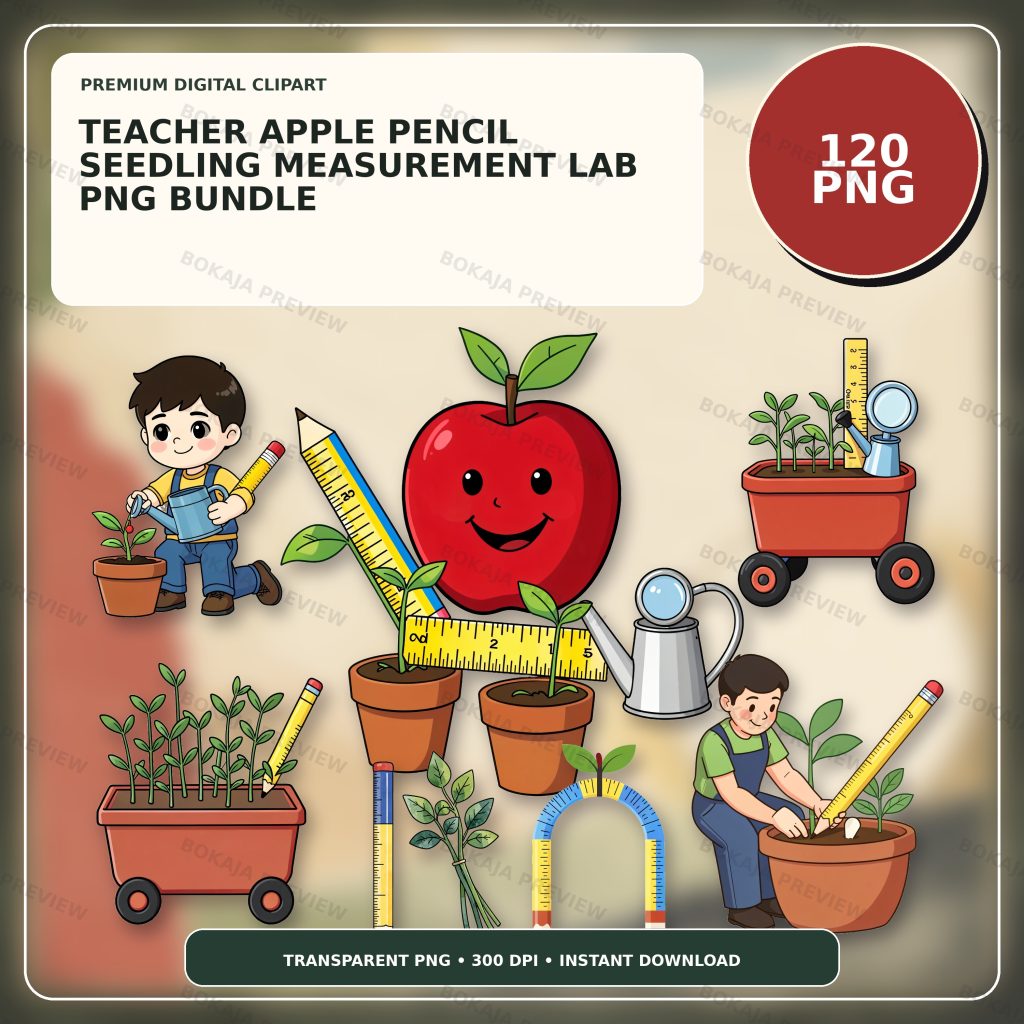
A teacher apple comparing two seedlings with a plain ruler can connect an observation sheet, plant label, measurement card, comparison slip, journal prompt, and closing checklist. The illustration is decorative: it does not identify a plant, measure growth, diagnose health, approve tools or substances, record learner performance, or replace adult guidance. Confirm the real garden or classroom activity first, then keep every changing fact editable.
Build one coordinated seedling lab set
The Teacher Apple Pencil Seedling Measurement Lab PNG Bundle is a live, purchasable digital product with 120 transparent PNG graphics at 3072 × 3072 px and 300 DPI metadata. Its original visual family centers on a friendly apple teacher comparing two seedlings with a plain ruler, plus coordinated school-garden, science-center, teacher-planner, and seedling-lesson elements.
The PNG files are visual source material. They are not seedlings, seeds, rulers, pots, soil, tools, printed worksheets, scientific results, plant-care advice, safety labels, or learner records. Add every practical fact in Canva, Cricut Design Space, or another suitable layout tool as live text so the responsible adult can correct it when the plant, date, unit, method, care plan, classroom rule, or learning objective changes.
Choose one main apple-and-seedlings graphic for the lab sign and two or three quieter ruler, leaf, pot, or pencil elements for smaller pieces. A limited visual family keeps the set coordinated while preserving clear space for the actual plant name, observation date, unit, measurement, method, care note, learner prompt, and help information.
Seedling measurement printable matrix
| Printable | Practical job | Editable facts | Responsible-adult check |
|---|---|---|---|
| Observation sheet | Record visible plant changes | Plant code, date, notes, sketch | Separate observation from inference |
| Plant label | Identify the actual specimen | Verified name, group, start date | Check the authoritative record |
| Measurement card | Record one repeatable measure | Point, tool, unit, value | Use the same method each time |
| Comparison slip | Compare two dated observations | Dates, values, difference | Avoid causal claims |
| Journal prompt | Guide a learning reflection | Prompt, evidence, response space | Match the real lesson |
| Closing checklist | End the activity safely | Tools, cleanup, storage, initials | Confirm materials and handoff |
Each piece should do one clear job. Keep full curriculum, plant-care guidance, allergy information, chemical instructions, learner assessment, and safety procedures in their authoritative source. A decorative apple, ruler, seedling, leaf, or pot cannot establish species, growth rate, plant health, germination success, measurement accuracy, or suitability for a learner.
Confirm the real measurement method
“Seedling measurement” may mean height from soil line to the tallest point, leaf count, stem width, or a simple dated drawing. Choose one responsible-adult-approved method before creating the card. Define the starting point, tool, unit, schedule, and rounding rule so later values can be compared meaningfully. If the activity does not need a numerical measure, label it as an observation rather than inventing precision.
Collect the responsible adult, verified plant name or neutral code, planting date, observation date, measurement point, tool, unit, care source, approved substances, handwashing rule, allergy or sensitivity boundary, privacy choice, accessibility arrangement, supervision plan, learning objective, and help route. Use fictional plants, dates, names, codes, measurements, and responses in public examples.
Do not infer from the artwork that a ruler is calibrated, a plant is healthy, a seedling belongs to a certain species, or one treatment caused a change. The Surface Tension Classroom Printables guide offers another example of separating decorative science graphics from measured evidence, method notes, and responsible-adult decisions.
Keep units and observations clear
Place the teacher apple beside the measurement wording rather than behind it. Use a plain high-contrast typeface for plant codes, dates, units, values, method notes, care reminders, and help information. Decorative lettering can work for one short heading, but it should never carry facts needed to repeat a measurement or handle materials safely.
Use one unit consistently within a table and write the unit beside each value or clearly in the column heading. Distinguish visible observations such as “two new leaves” from interpretations such as “healthier.” Keep learner names, assessment results, health details, contact information, and support needs off public-facing cards. Avoid unsupported phrases such as “scientifically proven,” “safe for every child,” “supported growth,” or “perfectly accurate.”
Make a unit and handwriting-space proof
Fine roots, leaves, ruler marks, and pencil details can merge on kraft paper or disappear on a low-ink printer. Create a simplified version with one small graphic, dark live text, and a plain background. Print one observation sheet, plant label, and measurement card on the intended printer and material.
Check the smallest type, contrast, plant code, date, measurement point, units, value boxes, handwriting space, help route, cut lines, borders, holes, folds, and viewing distance. If using a cutter, test one sheet with the actual blade, mat, material, and current software settings. The PNG transparency and quality guide helps catch unwanted backgrounds and soft edges before producing the complete set.
Seedling lab checklist
- ☐ Confirm the responsible adult, real activity, plant identity or code, observation schedule, and help route.
- ☐ Define the measurement point, tool, unit, rounding rule, and recording method before collecting values.
- ☐ Keep dates, observations, measurements, care instructions, permissions, accessibility support, and handoff editable.
- ☐ Use fictional data in public examples and protect real learner names, results, contacts, health details, and records.
- ☐ Avoid unsupported species, growth, plant-health, causation, safety, accessibility, or educational claims.
- ☐ Confirm tool and substance controls, allergy boundaries, handwashing, supervision, cleanup, storage, and closure.
- ☐ Print the observation sheet, plant label, measurement card, comparison slip, journal prompt, and checklist at final size.
- ☐ Review the Bokaja digital product license before selling permitted finished physical items.
A soft product example
Product example: Put the teacher apple and paired seedlings on the main lab sign, repeat smaller rulers, leaves, pots, or pencils on observation and measurement cards, and keep verified science facts visually quiet and easy to replace. The Teacher Apple Pencil Seedling Measurement Lab PNG Bundle supplies a coordinated visual library while the responsible adult controls every plant name, date, method, unit, safety rule, permission, accessibility, and supervision decision.
The product is digital; no worksheet, label, ruler, seedling, seed, pot, soil, tool, paper, classroom equipment, or other physical item is shipped. After checkout, use the attached order-download PDF for package access. Read Digital Downloads and Refunds for current access and support details.
Related Bokaja tutorials
- Surface Tension Classroom Printables
- Apple Orchard Classroom Printables
- Classroom Labels and Teacher Stickers
- Canva vs Cricut for Transparent PNG Files
- How to Check PNG Transparency and Quality
- Bokaja Digital Product License
FAQ
Does the bundle include seeds, seedlings, rulers, or printed worksheets?
No. It contains transparent PNG graphics. Build the observation sheets, labels, cards, slips, prompts, and checklists in suitable layout software, then source and verify the real plants, materials, tools, methods, permissions, and instructions separately.
Can the seedling graphic identify a plant or tell me whether it is healthy?
No. Decorative artwork cannot identify a species, diagnose plant health, verify germination, measure growth, or establish that a care method is suitable. Use current authoritative information and responsible-adult judgment.
Can I use real learner measurements in public examples?
Use fictional data or neutral codes where possible. Keep real names, assessment results, contacts, health details, support needs, and other protected records out of public examples unless the responsible people have approved that use.
Can I sell finished plant-observation cards made with the graphics?
Review the digital product license first. Permitted finished physical products are different from reselling, sharing, uploading, extracting, or repackaging the original PNG or ZIP files.