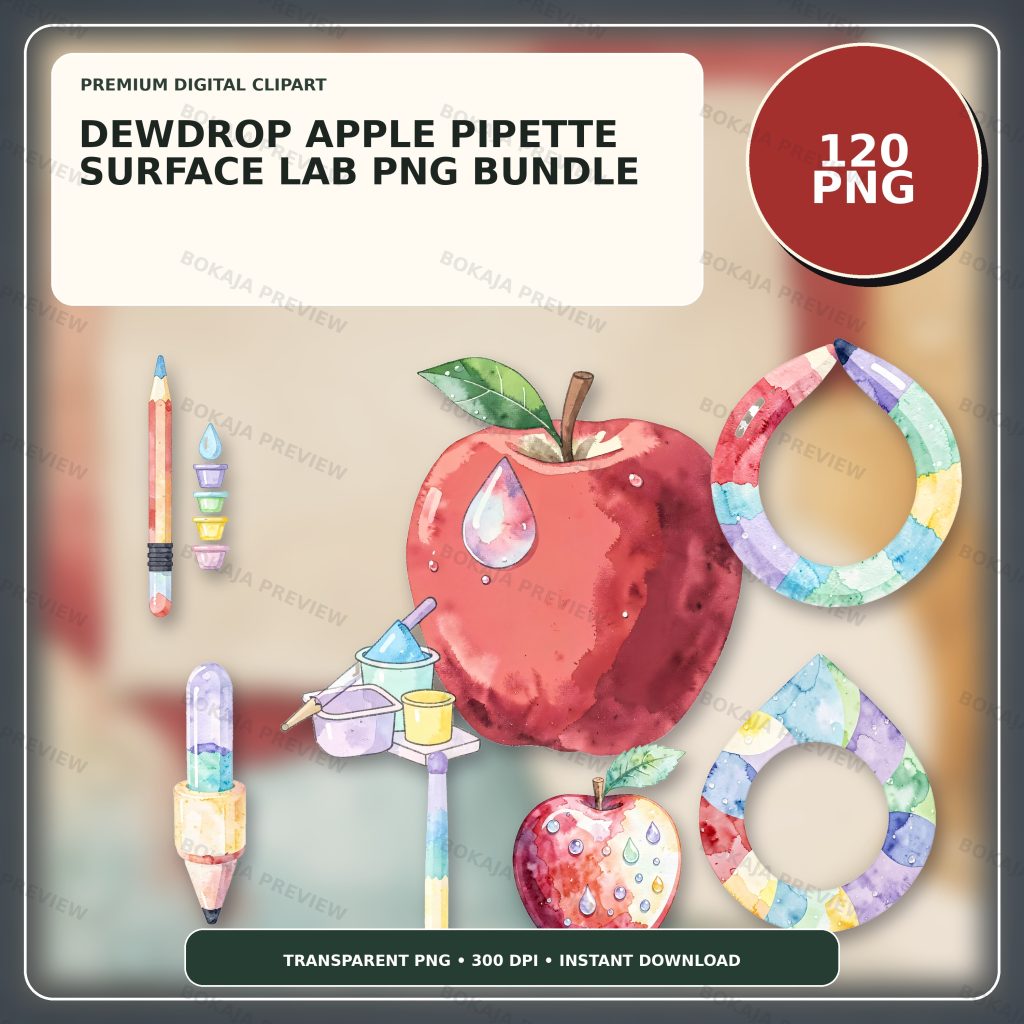
An apple teacher holding a pipette can make a water-drop science station easy to recognize, but the illustration cannot prove surface tension, measure a result, certify equipment, or replace spill, eye-safety, accessibility, and supervision guidance. Plan the real activity first, keep every changing fact editable, and use the graphics only as a coordinated visual layer.
Build one coordinated water-drop station
The Dewdrop Apple Pipette Surface Lab PNG Bundle is a live, purchasable digital product with 120 transparent PNG graphics at 3072 × 3072 px and 300 DPI metadata. Its original visual theme centers on an apple teacher transferring one water drop, with coordinated pipette, droplet, classroom, and surface-lab props.
The PNG files are decorative source material. They are not a science procedure, calibrated pipette, measurement tool, safety rule, age recommendation, accessibility plan, venue approval, or supervision policy. Put practical information in Canva, Cricut Design Space, or another suitable layout tool as live text. That makes it possible to correct the wording when the materials, test surface, method, room, or educator instructions change.
Choose one main apple-and-pipette image for the station sign and two or three quieter water-drop props for the smaller cards. A limited visual system keeps the set recognizable while leaving enough space for predictions, counts, and observations.
Surface-tension printable matrix
| Printable | Practical job | Editable facts | Responsible check |
|---|---|---|---|
| Prediction card | Capture an expectation before the activity | Prompt, fictional example, response field | Confirm wording and privacy approach |
| Surface card | Identify an approved test surface | Material name, condition, sample code | Verify against the actual item |
| Drop-count record | Record what the approved method asks for | Trial, count, unit, note | Confirm method and recording format |
| Station sign | Identify the approved activity | Name, group, time, room | Confirm schedule and venue rules |
| Observation label | Mark a sample or record | Date, condition, learner code | Protect privacy and avoid ambiguous labels |
| Reflection ticket | Prompt a concise follow-up | Question, name rule, next step | Check purpose and accessibility |
One clear purpose per printable is easier to use than a card overloaded with tiny instructions. Keep the complete procedure, risk assessment, equipment guidance, and accessibility plan in the educator's approved source. The printable should act as a readable prompt, not as a substitute for responsible instruction.
Verify the method before designing
Collect the activity name, responsible educator, actual materials, approved pipette or dropper, test surfaces, liquid, method, recording fields, spill rules, eye-safety rules, age guidance, accessibility arrangements, cleanup plan, and support route. Confirm every detail against the current lesson source and equipment instructions.
Do not infer from a smiling apple or drawn droplet that every surface, liquid, or pipette will behave the same way. Artwork cannot establish volume, cleanliness, surface condition, result, scientific explanation, allergy risk, or learner suitability. If the approved method changes, edit the live text instead of embedding the instruction inside an image.
Use fictional names and sample results in public examples. Keep learner records, medical details, contact information, support needs, and attendance data out of visible printables and portfolio images. The prism light science classroom printables guide shows a related way to separate a cheerful visual theme from verified science instructions.
Keep observations readable
Use strong headings, short prompts, high contrast, and generous white space. Place the droplet artwork beside the wording rather than behind it. A station sign may use a larger illustration, while a count record needs open columns and enough writing room for the intended response method.
Avoid unsupported labels such as “perfectly accurate,” “safe for every age,” “proves surface tension,” “allergy free,” or “works every time.” Those claims depend on the exact materials, method, audience, conditions, and responsible guidance. If the activity compares surfaces, use neutral sample names until the educator verifies the actual materials.
Make a low-ink final-size proof
Pale blue droplets and fine pipette details can fade on some home printers or colored paper. Make a low-ink version with one small graphic, dark live text, and a plain background. Print one station sign and one drop-count record on the intended printer and paper.
Check the smallest type, response fields, units, surface names, trial numbers, cut lines, folds, attachment points, and viewing distance. If using a cutter, test one sheet with the real blade, mat, material, and software settings. The PNG transparency and quality guide helps identify unwanted backgrounds and soft edges before producing a batch.
Surface-tension printable checklist
- ☐ Confirm the responsible educator, approved activity, room, time, and learner group.
- ☐ Verify the actual liquid, pipette, surfaces, method, units, recording fields, and boundaries.
- ☐ Keep materials, prompts, counts, results, times, instructions, and support details editable.
- ☐ Avoid unsupported claims about accuracy, safety, supported results, age suitability, or learning outcomes.
- ☐ Keep medical, contact, attendance, and other private information out of public samples.
- ☐ Confirm permissions, accessibility, spill and eye-safety rules, supervision, and cleanup.
- ☐ Print the prediction card, surface card, drop-count record, station sign, observation label, and reflection ticket at final size.
- ☐ Review the Bokaja digital product license before selling permitted finished physical items.
A soft product example
Product example: Put the apple teacher and pipette on the station sign, repeat small droplets or surface-lab props on prediction and reflection cards, and keep the drop-count record visually quiet. The Dewdrop Apple Pipette Surface Lab PNG Bundle supplies a coordinated visual library while the educator controls every material, method, safety, accessibility, and privacy decision.
The product is digital; no pipette, liquid, science kit, worksheet, printed card, or physical classroom item is shipped. After checkout, open the attached order-download PDF to access the download area ZIP package. Read Digital Downloads and Refunds for current access and support details.
Related Bokaja tutorials
- Prism Light Science Classroom Printables
- Pocket Sundial Classroom Printables
- Classroom Labels and Teacher Stickers
- Canva vs Cricut for Transparent PNG Files
- How to Check PNG Transparency and Quality
FAQ
Does the bundle include a complete surface-tension experiment or worksheet?
No. It contains transparent PNG graphics. Build the cards, labels, and records in suitable layout software, and use the responsible educator's current procedure, materials, and equipment guidance for the real activity.
Can the artwork measure drops or prove a scientific result?
No. A decorative image cannot calibrate a pipette, verify a surface, measure volume, establish a result, or confirm a scientific explanation. Record only what the approved method asks learners to observe.
Can these printables replace spill, eye-safety, or supervision guidance?
No. Follow current equipment instructions, venue rules, accessibility arrangements, the approved lesson plan, and qualified guidance where needed. Decorative printables cannot supervise participants.
Can I sell finished science-station cards made with the graphics?
Review the digital product license first. Permitted finished physical products are different from reselling, sharing, uploading, extracting, or repackaging the original PNG or ZIP files.