A rainbow pencil and prism-light stage can make a classroom science station easy to recognize, but decorative artwork cannot validate an experiment, identify a safe light source, certify equipment, or replace eye-safety and supervision guidance. Build the real activity plan first, keep critical facts editable, and use the graphics only as a coordinated visual layer.
Build one coordinated light-science station
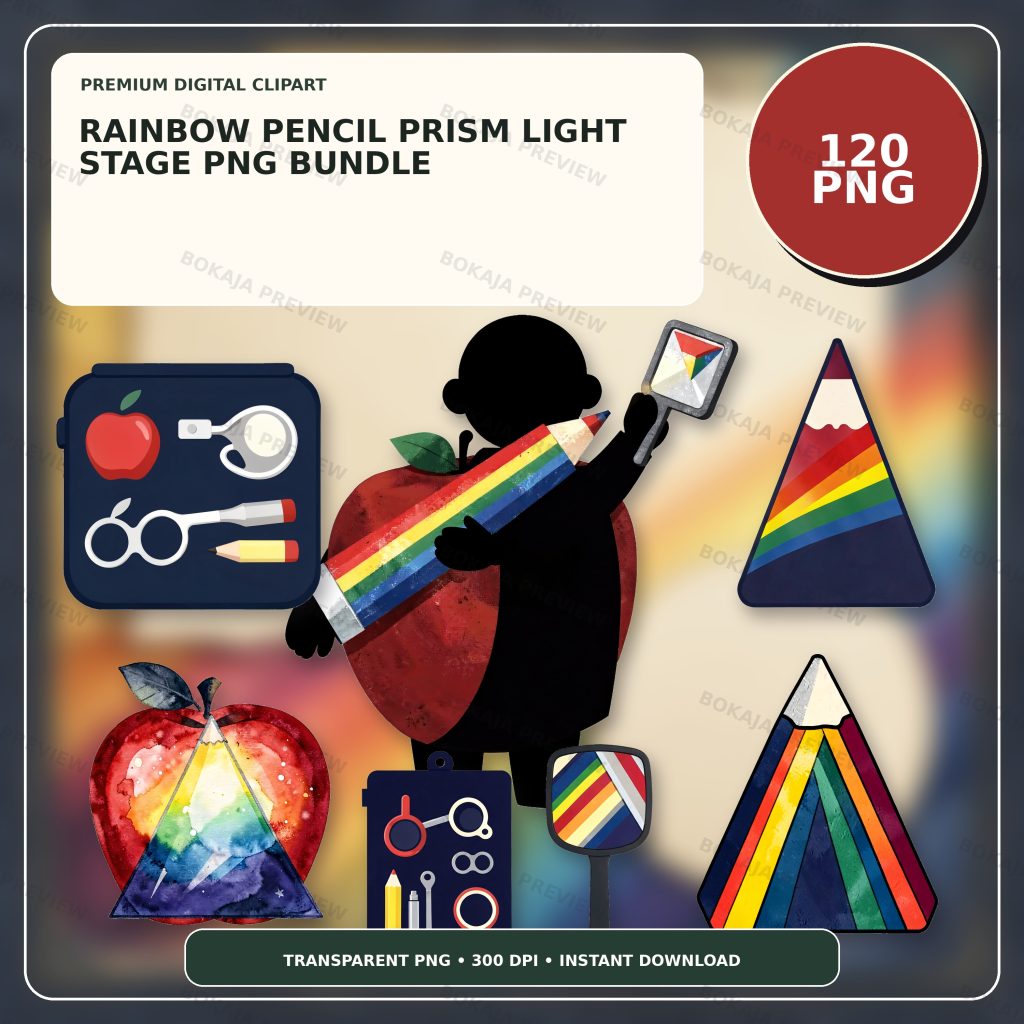
The Rainbow Pencil Prism Light Stage PNG Bundle is a live, purchasable digital product with 120 transparent PNG graphics at 3072 × 3072 px and 300 DPI metadata. Its original visual theme centers on an apple teacher directing light through a prism, with coordinated rainbow-pencil, optics, color, and classroom-stage props.
The PNG files are decorative source material. They are not an optics procedure, equipment specification, eye-safety rule, age recommendation, accessibility plan, venue approval, or supervision system. Add all practical information in Canva, Cricut Design Space, or another suitable layout tool so the responsible person can correct it when equipment, room conditions, or instructions change.
Choose one main teacher-and-prism image for the station sign and a limited family of pencils, color shapes, or light props for the smaller pieces. A restrained design leaves observation records readable and prevents decoration from looking like an instruction.
Prism light printable matrix
| Printable | Practical job | Editable facts | Responsible check |
|---|---|---|---|
| Light-source card | Identify approved equipment | Source name, setup note, boundary | Verify against the actual equipment |
| Prediction card | Record a learner's expectation | Prompt, fictional example, response field | Confirm wording and privacy approach |
| Color-order label | Label an observed or taught sequence | Current terms and order | Review against the lesson source |
| Observation record | Capture what is actually seen | Date, condition, result, note | Confirm units and recording method |
| Station sign | Identify the approved activity | Name, group, time, room | Confirm schedule and venue rules |
| Reflection ticket | Prompt a concise follow-up | Question, name rule, next step | Check purpose and accessibility |
One clear purpose per printable is easier to use than a card overloaded with fine print. Keep detailed procedure, equipment, safety, and accessibility information in the educator's approved source and use the visual set as a readable pointer.
Verify equipment and wording first
Before designing, collect the activity name, responsible educator, actual equipment, approved light source, setup boundaries, procedure, observation terms, age guidance, accessibility arrangements, room conditions, cleanup steps, and support route. Confirm every detail with the responsible person and current equipment instructions.
Do not infer from a rainbow illustration that a result will appear, that every prism or light source behaves the same way, or that a setup is suitable for every learner. Artwork cannot assess glare, beam direction, electrical equipment, eye exposure, fragile materials, room layout, or supervision. If any fact changes, edit the live text rather than embedding it inside an image.
Use fictional names and observations in public examples. Keep learner records, medical details, contact information, support needs, and attendance data out of visible printables and portfolio images. The space classroom printables guide offers a related example of using themed graphics without turning them into scientific instructions.
Keep science text readable
Use large headings, short prompts, strong contrast, and plain backgrounds. Place the rainbow-pencil artwork beside the wording, not behind it. Give the observation record enough blank space for the intended response method, and make separate versions if different learners or stations need genuinely different instructions.
Avoid unsupported labels such as “eye safe,” “works every time,” “correct spectrum,” “for all ages,” or “teacher approved.” Those claims depend on the exact source, prism, setup, audience, conditions, method, and responsible guidance. Decorative color order should not be mistaken for a measured result unless the educator has verified that wording for the real lesson.
Print and cut a final-size proof
Rainbow gradients, pale yellow beams, and fine pencil details can lose clarity on home printers or colored paper. Make a low-ink version with one small graphic, dark live text, and a white or quiet background. Print one station sign and one observation record using the intended printer and paper.
Check the smallest type, response fields, color terms, equipment names, boundary notes, cut lines, folds, attachment points, and viewing distance. If using a cutter, test one sheet with the real blade, mat, material, and software settings. The PNG transparency and quality guide helps identify unwanted backgrounds and soft edges before producing a batch.
Light-science printable checklist
- ☐ Confirm the responsible educator, approved activity, room, time, and learner group.
- ☐ Verify the actual prism, light source, equipment, procedure, observation terms, and boundaries.
- ☐ Keep equipment names, prompts, results, times, instructions, and support details editable.
- ☐ Avoid unsupported claims about safety, supported results, scientific accuracy, age suitability, or learning outcomes.
- ☐ Keep medical, contact, attendance, and other private information out of public samples.
- ☐ Confirm permissions, accessibility, room setup, eye-safety rules, supervision, and cleanup.
- ☐ Print the source card, prediction card, color label, observation record, station sign, and reflection ticket at final size.
- ☐ Review the Bokaja digital product license before selling permitted finished physical items.
A soft product example
Product example: Put the apple teacher and prism-light graphic on the station sign, repeat small pencil or color props on prediction cards and reflection tickets, and keep the observation record visually quiet. The Rainbow Pencil Prism Light Stage PNG Bundle supplies a coordinated visual library while the educator controls every equipment, method, safety, accessibility, and privacy decision.
The product is digital; no prism, lamp, science kit, worksheet, printed card, or physical classroom item is shipped. After checkout, open the attached order-download PDF to access the download area ZIP package. Read Digital Downloads and Refunds for current access and support details.
Related Bokaja tutorials
- Classroom Labels and Teacher Stickers
- Art-Center Labels Printables
- Space Classroom Printables
- How to Use Canva for Beginners
- How to Check PNG Transparency and Quality
FAQ
Does the bundle include a complete prism experiment or science worksheet?
No. It contains transparent PNG graphics. Build the cards, labels, and records in suitable layout software, and use the responsible educator's current procedure and equipment guidance.
Does the rainbow artwork prove what learners will observe?
No. A decorative image cannot verify a result, spectrum, light source, prism, room condition, or method. Record only what the approved lesson asks learners to observe.
Can these printables replace eye-safety or supervision instructions?
No. Follow current equipment instructions, venue rules, accessibility arrangements, the approved lesson plan, and qualified guidance where needed. Decorative printables cannot supervise participants.
Can I sell finished classroom cards made with the graphics?
Review the digital product license first. Permitted finished physical products are different from reselling, sharing, uploading, extracting, or repackaging the original PNG or ZIP files.