To make baby shower games, choose activities guests can understand quickly, write the complete instructions before decorating, and prepare any answer sheet or scoring rule at the same time. A small set of welcoming games is more useful than a large pack with unclear rules.
Choose Baby Animal Nursery for a nursery-themed wishes card, or Animal Fairy Meadow Post Office for a storybook alternative. Both are paid PNG artwork collections for layouts you design yourself; add your own text, shapes and measurements.
Make it with these Bokaja sets
Choose the style that fits your project. These are digital PNG artwork collections: add your own text and build the layout shown in this guide.

Baby Animal Nursery
Baby-animal artwork for a nursery-themed wishes card.

Animal Fairy Meadow Post Office
Fairy meadow artwork for a storybook alternative.
Worked example: a 5 × 7-inch wishes card guests can finish
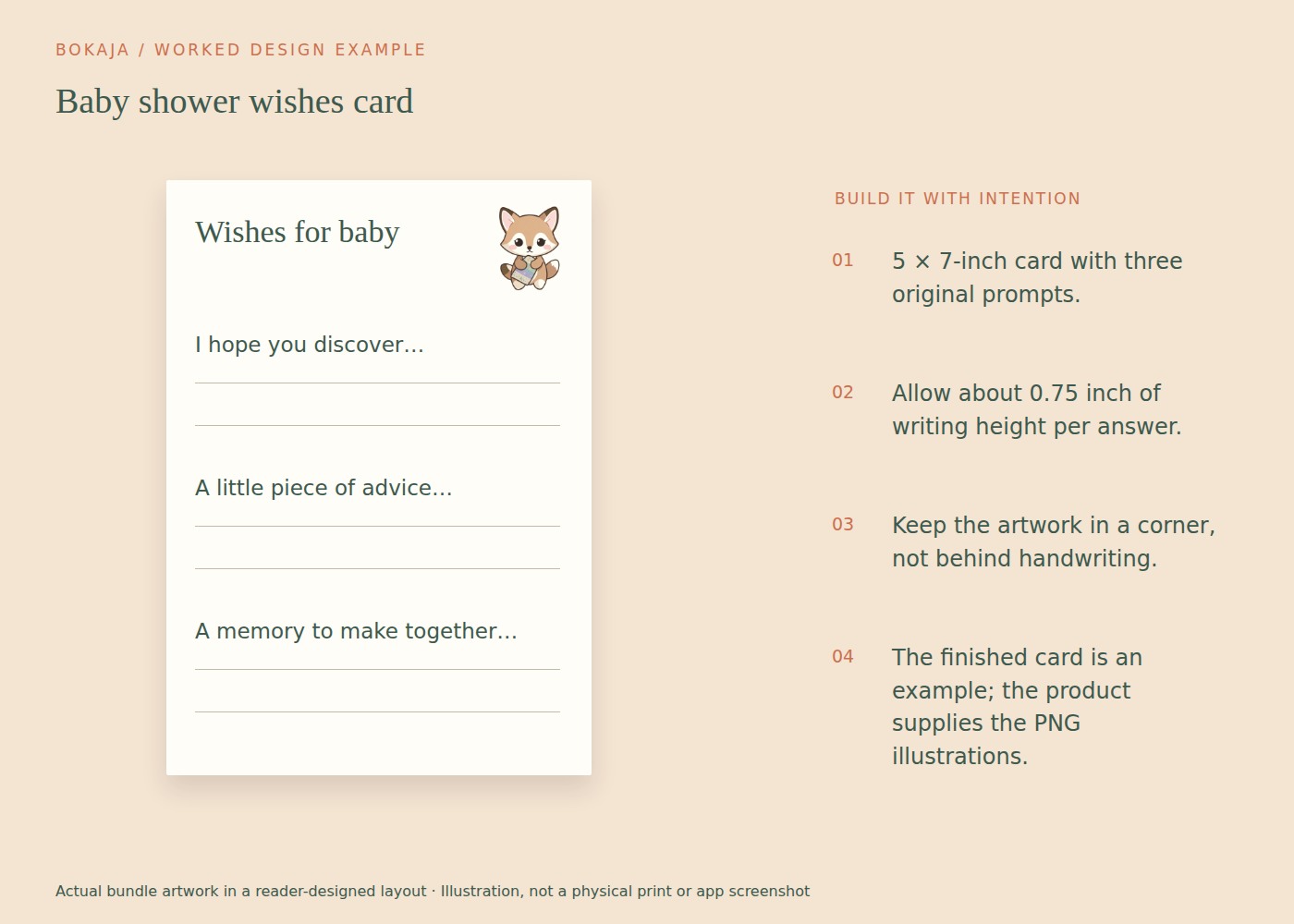
Use the baby-animal collection for a small decorative corner, then create the prompts and writing lines yourself. A wishes card is an activity you design from the PNG artwork, not a finished game supplied in the bundle.
Create a 5 × 7-inch page with 0.375-inch margins. The inner area is 4.25 × 6.25 inches. Give the title about 0.75 inch, then divide the main body into three prompt-and-response blocks. Leave at least 0.75 inch of handwriting depth for each response rather than filling those spaces with illustration.
Three welcoming prompts are “A small kindness I hope you know,” “Something I would love to show you” and “A wish for your family.” They invite different answers without requiring guests to give parenting advice or disclose personal experiences. Add “Choose one or more” so nobody feels obliged to complete every line.
Place a 0.75-inch artwork accent near the title or bottom corner, outside the response areas. Use readable prompt text and pale enough ruling that handwriting remains dominant. Print on a stock that works with the pens you will provide; glossy paper can look attractive but make writing awkward.
For a companion memory game, keep the guest sheet and host answer list separate. The artwork can match, but the instructions, timing and scoring need their own clear text. Do not print an answer key on the reverse without considering show-through and accidental visibility.
Make one proof and write on it with the actual pen. If an ordinary response needs three lines but you left one, enlarge the space or reduce the number of prompts. A card that is easy to complete is a better keepsake than a crowded sheet with many unanswered questions.
Decide how much structure the event needs
Ask the host whether guests want games, conversation or a mixture. Keep participation optional and choose activities that do not require intimate personal disclosures, physical contact or assumptions about family roles.
Plan the time, materials and group size. A seated writing activity needs pens and a surface; a spoken group game may be easier in a small living room. Avoid scheduling several games simply because you have printed them.
Use inclusive wording that fits the actual family. Confirm names and preferred terms with the host before making personalized sheets.
Game one: baby-item alphabet brainstorm
Create a sheet with ten selected letters and a blank line beside each. For example, use B, C, D, H, M, P, R, S, T and W. Ask guests to write an item associated with caring for a baby for each letter.
Possible answers include blanket, changing mat, diaper, hat, muslin, pram, rattle, socks, towel and wipes. Regional vocabulary varies, so accept reasonable alternatives rather than treating one word list as universal.
Give guests a short time agreed by the host, then invite a few answers. You can award one point per reasonable entry or use it as a noncompetitive conversation starter. State the chosen rule on the sheet so scoring is not invented afterward.
Game two: nursery bag memory list
The host displays a tray or bag containing a small selection of ordinary baby-care items. Guests look for a set period, the items are covered, and everyone writes what they remember.
Create a numbered answer area and a host checklist of the actual items. Use perhaps eight to ten objects for a manageable first version, adjusting to the group. Do not use essential supplies in a way that damages or contaminates them.
Score one point per correctly remembered item if competition suits the event. Accept clear descriptions even when the exact product name differs. The actual displayed objects—not clipart printed on the sheet—determine the answers.
Game three: advice and wishes cards
This is an activity rather than a scored quiz. Give each guest a card with two optional prompts: “A small kindness I hope you receive” and “One practical idea you can keep or ignore.” Leave room for a name if the guest wants to add it.
Avoid presenting advice as a test of parenting knowledge. Ask guests to keep suggestions supportive and respect the family’s choices. A blank card is also a valid option for someone who would rather write a personal message.
Provide a box or envelope so the family can read the cards privately later. Do not require guests to read personal messages aloud.
Prepare the host copy separately
The host should have the rules, timing, actual memory-game list and any scoring guidance on one plain page. Mark it clearly so it is not accidentally handed out as a guest sheet.
Check that every question or task has a fair interpretation. Remove anything that depends on an unverified fact or an assumption about the guests’ experiences.
Count pens and printed sheets, with a few spares. Keep an alternative conversational activity available rather than treating the printed plan as compulsory.
Finish with rights and privacy in mind
Use the family’s information only with permission and avoid publishing completed wishes or guest names without consent. Review the current artwork licence before selling or distributing digital game files containing purchased graphics.
The strongest result is not the most elaborate pack. It is a small set of activities the host can explain easily and guests can join comfortably.
Your next step
Keep the guest sheets and host notes in separate files. Proof instructions and handwriting space before making more decorative variations.
Start with Baby Animal Nursery, or choose Animal Fairy Meadow Post Office for the alternative theme described above. These collections supply PNG illustrations for your own layout; the project text and construction remain yours.