An autumn nature journal works best when its pages help you notice what is actually outside. Build a small set of observation layouts with generous writing and drawing space, then use clipart sparingly to organize the pages rather than supply the observations.
Choose Autumn Animal Leaf Pressing Club for the autumn heading, or Chickadee Pinecone Feeder Workshop for a birdwatching page. Both are paid PNG artwork collections for layouts you design yourself; add your own text, shapes and measurements.
Make it with these Bokaja sets
Choose the style that fits your project. These are digital PNG artwork collections: add your own text and build the layout shown in this guide.

Autumn Animal Leaf Pressing Club
Leaf-pressing artwork for the autumn heading.
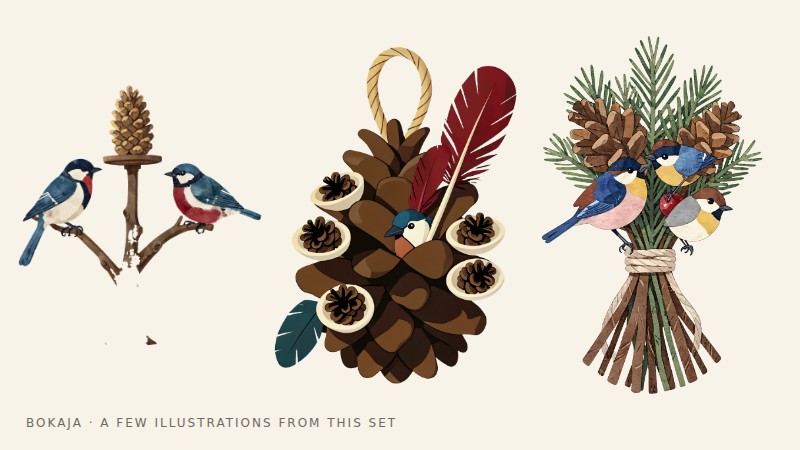
Chickadee Pinecone Feeder Workshop
Pinecone-feeder workshop artwork for a birdwatching page.
Worked example: a Letter-size autumn observation page

Create an 8.5 × 11-inch page with half-inch margins. Use a small leaf-pressing PNG in the heading, then leave the observation area for what you actually see outdoors. Decorative artwork should not be mistaken for a specimen record.
Place a 4 × 4-inch sketch box below the heading. To its right, reserve a 3 × 4-inch notes block, separated by a 0.5-inch gap. Together they occupy the 7.5-inch content width: 4 + 0.5 + 3. Below them, add two prompts with generous writing space: “What changed since my last visit?” and “What would I like to check next time?”
In the notes block, include date, location description and weather observations. Use wording such as “cool and windy” if that is what you observed; do not invent an exact temperature without a measurement. If a species identification is uncertain, write “unknown” or a tentative description and investigate later.
A birdwatching version can use the pinecone-feeder workshop collection in the heading. Keep the record fields focused on actual sightings and behavior rather than implying the decorative image is a field-identification guide.
Print one page and take it on a short outing with the intended pencil and clipboard. A 4-inch sketch box may be generous on screen but awkward if the page has no firm support. If portability matters more, redesign for A5 instead of scaling down the entire Letter page and making the labels tiny.
After returning, add a photograph or a follow-up identification note only where it helps the record. Preserve the distinction between an observation made outside and a later interpretation. That makes the journal useful for noticing change over time.
Page one: notice a place
Give the page fields for date, location description and weather observations. Leave a large drawing box and two prompts: “What caught my attention?” and “What do I want to look at again?”
Keep observations separate from guesses. “Three leaves had brown edges” is an observation; “the tree is sick” is an interpretation that may require more knowledge. A journal can record questions without pretending to answer them immediately.
Use a location description that is useful to you without exposing sensitive wildlife sites or private information if the page will later be shared.
Page two: look closely at one subject
Create a large area for a leaf, seed, twig or other subject to be drawn. Add smaller spaces for shape, texture and color notes. A ruler line or measured-size field can help distinguish a tiny object from a large one.
Encourage drawing what is visible rather than tracing decorative clipart. The illustration in the page heading should not become an answer the observer feels expected to copy.
If identification matters, consult an appropriate field guide or knowledgeable source. Do not infer that a plant is edible or safe to handle from a stylized image or a journal label.
Page three: return and compare
Divide the page into two or three dated observation areas for the same place or subject. Ask “What changed?” and “What stayed similar?”
This can work for a tree viewed from a path, a garden bed or a familiar patch of ground. Keep the viewpoint reasonably consistent when comparing drawings or photographs, but allow room for unexpected details.
Record the actual dates rather than assuming a weekly interval happened. Missing a visit does not make the journal unusable; it simply changes what you can compare.
Use autumn artwork as a modest guide
A small leaf accent, woodland animal or border can distinguish the journal sections. Leave the central observation space plain and keep the decoration light enough for economical printing.
If a graphic is whimsical, treat it as decoration. It should not stand in for a field-identification diagram.
Plan a responsible outing
Choose a location and route appropriate for the participants, weather and available supervision. Follow site rules, stay out of restricted areas and avoid disturbing wildlife.
Observe objects in place when possible. Collect only where permitted and appropriate, and avoid handling unfamiliar plants, fungi or animal remains. A drawing or photograph can record a find without removing it.
For children, agree on boundaries and practical routines before the activity. The journal is one part of the outing, not a substitute for supervision or local safety planning.
Proof the page by using it
Print a few pages and take them on a short familiar walk. Can you write comfortably on the surface? Is there enough room for an ordinary observation? Are the prompts useful, or do they interrupt looking?
Revise the page after this test. Remove fields you never use and enlarge the spaces that fill too quickly. Keep a dated master so you can see which version worked.
The related leaf-pressing activity guide covers a different craft context. Your nature journal can remain simpler: a record of real attention, supported by a clear page layout and a willingness to leave some questions open.
Your next step
Keep your observations distinct from decorative illustrations and later identifications. The next visit becomes more interesting when the page shows what you actually noticed before.
Start with Autumn Animal Leaf Pressing Club, or choose Chickadee Pinecone Feeder Workshop for the alternative theme described above. These collections supply PNG illustrations for your own layout; the project text and construction remain yours.
For commercial or shared deliverables, check the current artwork licence for the intended use.