Price handmade printed products by counting the full cost of making and selling them, including your time, waste and transaction fees. Then test whether the resulting price makes sense for the product and customers. A costing formula can reveal the economics; it cannot guarantee demand.
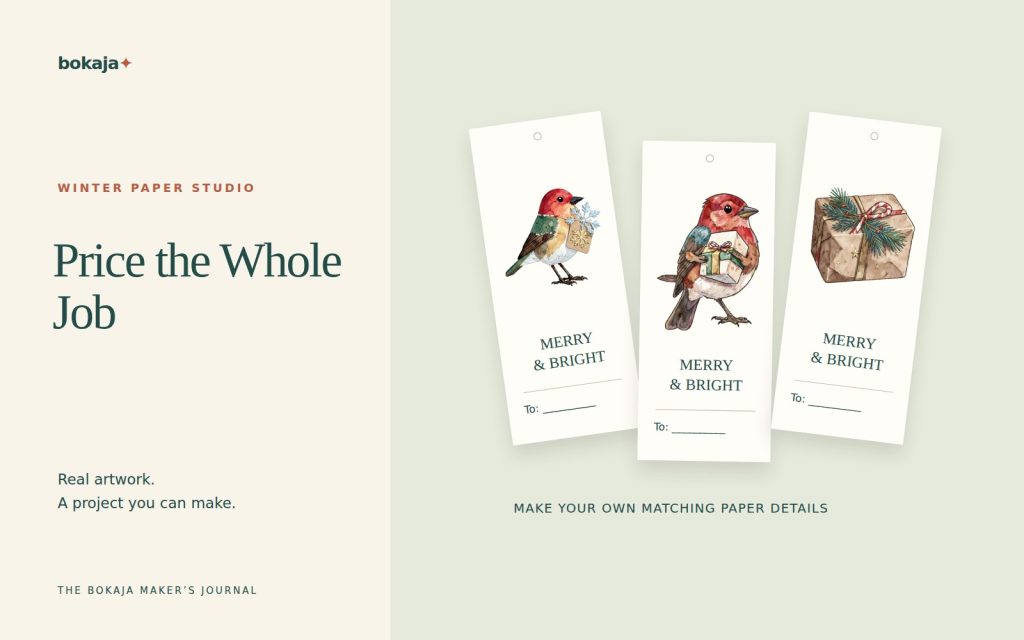
Choose Watercolor Christmas Robin Gift-Wrapping Studio for the costed tag batch, or Puppy Birthday Bakery for a party-favor pricing variation. Both are paid PNG artwork collections for layouts you design yourself; add your own text, shapes and measurements.
Make it with these Bokaja sets
Choose the style that fits your project. These are digital PNG artwork collections: add your own text and build the layout shown in this guide.

Watercolor Christmas Robin Gift-Wrapping Studio
Gift-wrapping artwork for the costed tag batch.
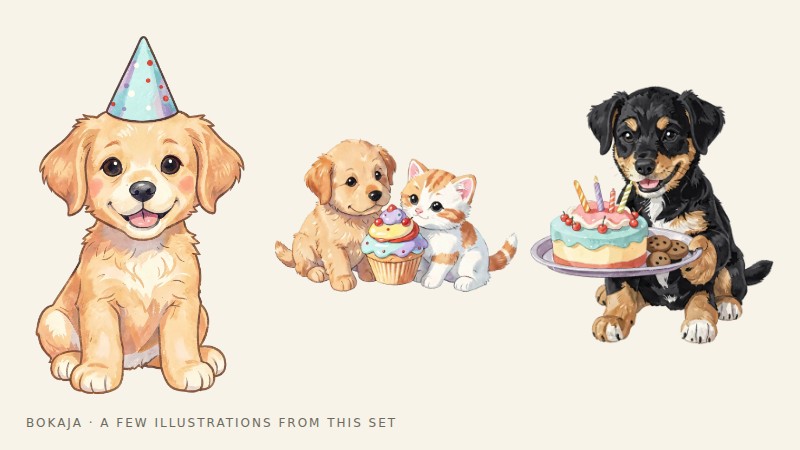
Puppy Birthday Bakery
Birthday artwork for a party-favor pricing variation.
Worked example: cost forty saleable gift tags
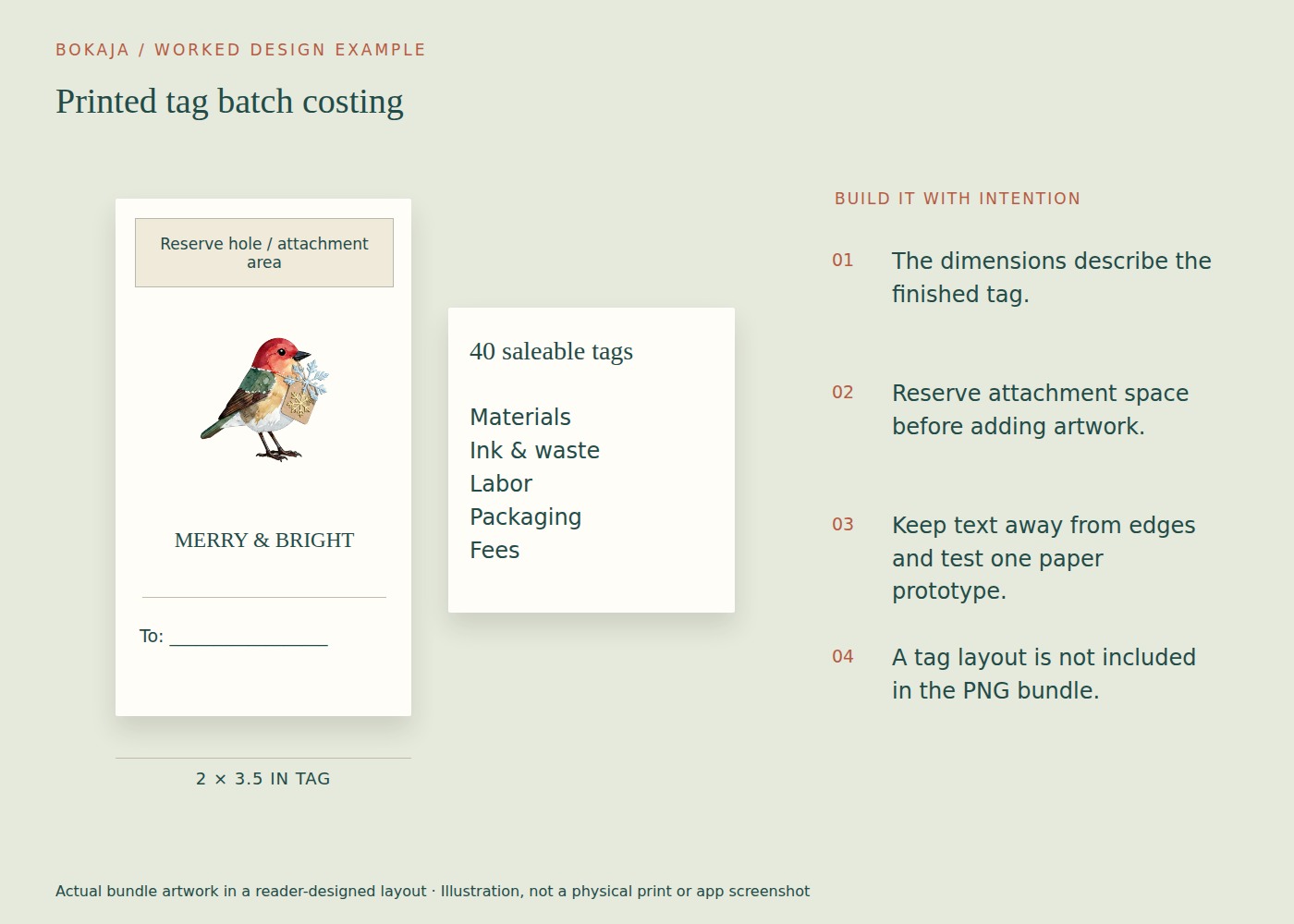
Design a 2 × 3.5-inch printed tag with gift-wrapping artwork. Define the selling unit as a pack of ten tags, so forty saleable tags make four packs. The following amounts are illustrative costing inputs, not Bokaja product prices or a claim about current marketplace fees.
Assume the batch uses six sheets at €0.60 each: €3.60. Ink is €1.20, ribbon is €2.00, and packaging for four packs is €2.40. These materials total €9.20. If forty-five tags were printed but only forty are saleable, the cost of all used sheets and ink still belongs to the forty good tags; do not count the failed pieces as saleable stock.
Add forty-five minutes of labor at €16 per hour: €12.00. Allocate €2.80 of overhead and €1.00 of artwork cost to this batch using your own documented allocation method. The batch cost is now €25.00, or €6.25 per pack. The artwork allocation is a business assumption, not the purchase price of either linked collection.
Suppose the channel charges 8% of the selling price plus €0.30 per order, and each order contains one pack. To leave €3 above the stated costs, calculate:
Price = (€6.25 + €0.30 + €3.00) ÷ (1 − 0.08) = €10.38, rounded to cents.
At €10.38, the percentage fee is about €0.83, leaving approximately €3 after the cost and fixed fee. This simplified example excludes shipping and tax; include them according to your actual business and fee rules before setting a real price.
If a buyer orders two packs together, the fixed order fee may be paid once rather than twice. Model that order separately. Likewise, personalized wording adds labor even when the paper cost stays unchanged. Price the work you actually deliver, then evaluate whether the offer and market support that price.
Define the unit you are selling
Decide whether one unit means a single card, a pack of six, a personalized set or another clearly described product. List exactly what is included: envelope, backing card, packaging, personalization and any assembly.
Separate shipping from the product calculation initially, then decide how it will be charged. “Digital download” still has a cost that must be covered somewhere.
If several items share a print sheet, calculate their usable yield. A sheet that theoretically holds twelve labels may produce fewer saleable pieces after margins, test cuts or occasional errors.
Count materials and production waste
Include paper or sticker stock, ink or toner, adhesive, supports, envelopes and packaging. Use your actual purchase costs and quantities rather than a generic estimate from a different printer or country.
Allow for realistic waste. If a batch uses ten sheets but only nine become saleable output, the cost of all ten belongs in the batch. Do not add an arbitrary waste percentage and then count the same failed sheets again.
Track a few real batches to improve the estimate. Until then, label your assumptions clearly so you know which numbers need replacing.
Pay attention to labor
Record the time spent preparing files, personalizing, printing, cutting, assembling, checking and packing. Include order-specific communication when it is a regular part of the product.
Choose a labor rate for planning and calculate time consistently. Ten minutes at an assumed rate of €18 per hour contributes €3 of labor per unit.
Batch work can reduce time per item, but do not assume every order arrives in the ideal batch size. A one-off personalized order may need a different price or minimum quantity from a standard stock item.
Add overhead without pretending it is free
Equipment wear, software, workspace costs and other business expenses need a reasonable allocation. The appropriate method depends on the business; a simple per-unit allowance can be a starting estimate if you document how it was chosen.
Artwork purchases also belong in the economics. Allocate their cost sensibly across the products they actually support, while respecting the current artwork licence. Paying for a file does not remove its use restrictions.
Do not count the same expense both as a direct material and again inside a broad overhead allowance.
Separate margin from markup
Adding 50 percent to a €4 cost gives a €6 price. That is a 50 percent markup on cost, but the €2 difference is one-third of the selling price, or about a 33 percent margin before other expenses.
Use the terms consistently so a spreadsheet does not hide a weaker result than expected. In management accounting, contribution normally means sales minus variable costs, before fixed overhead. The €2 in this example is a surplus after the specific labor and overhead allowances listed, not a fully established net profit; taxes and any omitted costs still matter.
Test the offer, not only the formula
Compare the proposed price with genuinely comparable products: materials, quantity, personalization, finish and delivery. If the price seems difficult to support, examine the product, batch process or included service rather than quietly valuing your labor at zero.
Track real orders, time and waste, then revise the model. Do not claim a project “will sell” because its materials are inexpensive. A useful price is one that honestly covers the chosen economics and can be evaluated against actual customer response.
Your next step
Replace every illustrative cost with your own recorded number. Then compare pack sizes, personalization time and order fees before choosing the offer that earns enough for the work.
Start with Watercolor Christmas Robin Gift-Wrapping Studio, or choose Puppy Birthday Bakery for the alternative theme described above. These collections supply PNG illustrations for your own layout; the project text and construction remain yours.