Advent activity cards work best when they make room for an ordinary December, not an imaginary month with unlimited time and energy. Build a flexible collection of small activities, include quiet alternatives, and let the household move or skip cards when plans change.
Choose Gingerbread Reindeer Toymaker Mail Cart for a festive card theme, or Snowman Cocoa Cart Winter Market for an indoor cozy-day card. Both are paid PNG artwork collections for layouts you design yourself; add your own text, shapes and measurements.
Make it with these Bokaja sets
Choose the style that fits your project. These are digital PNG artwork collections: add your own text and build the layout shown in this guide.

Gingerbread Reindeer Toymaker Mail Cart
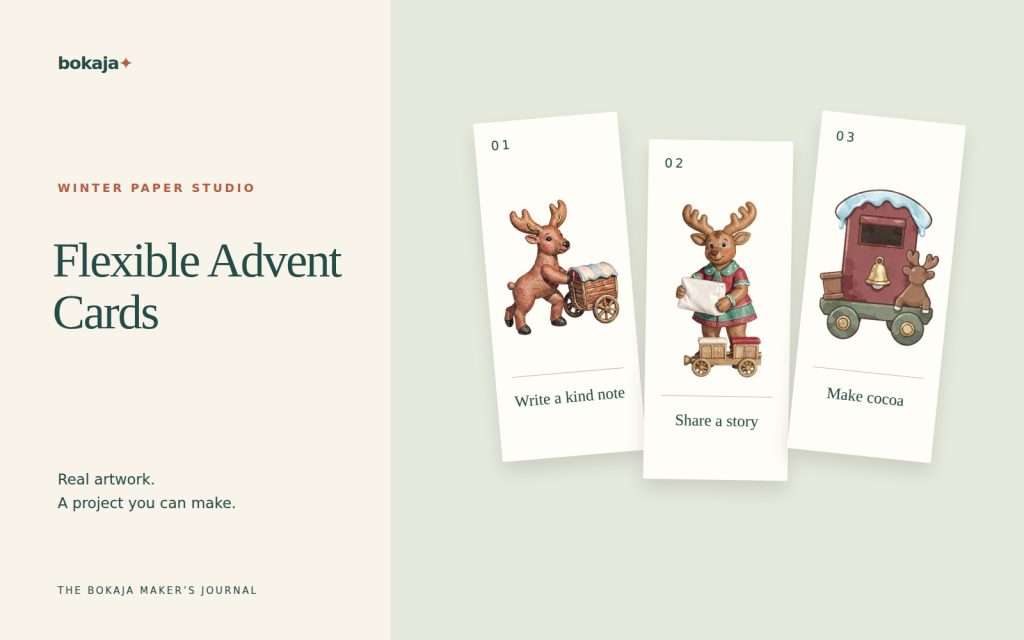
Holiday mail-cart artwork for a festive card theme.

Snowman Cocoa Cart Winter Market
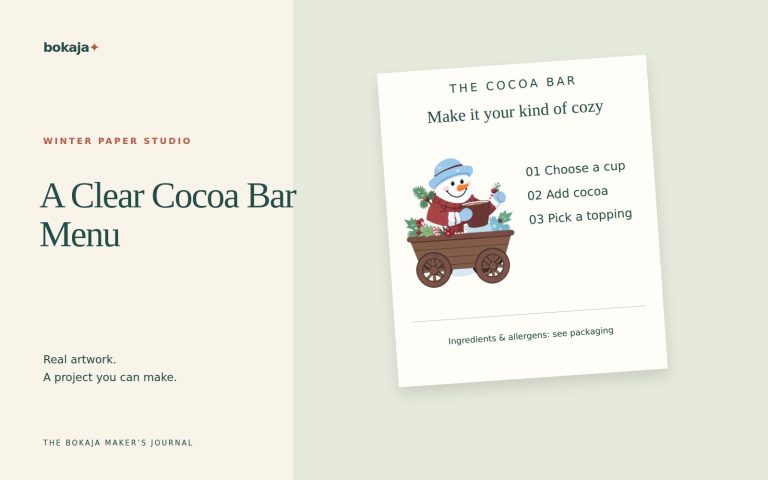
Cocoa market artwork for an indoor cozy-day card.
Worked example: twenty-four cards that do not lock the calendar

Create a 3 × 4-inch activity card and keep the day number separate from the activity wording. Use a small holiday mail-cart illustration on the master, with cocoa-market artwork for a cozy indoor variation. You type the numbers and prompts yourself.
Inside quarter-inch margins, you have 2.5 × 3.5 inches of content space. Give the activity title about half an inch, the instructions roughly 1.5 inches and a small illustration the remaining lower area. Keep a short preparation note on the reverse or in a separate adult list if it would clutter the guest-facing card.
Write each activity as an achievable invitation: “Choose one winter story and read it together” is more complete than “Books.” For cocoa, name the actual plan and who prepares the hot drink rather than leaving a vague “Cocoa night” that assumes ingredients and time are available.
Sort twenty-four cards into low-effort, moderate-effort and planned-outing groups. Put the low-effort options where ordinary weekdays are likely to need them. Use numbered envelopes or removable number tabs so you can change the order without reprinting the artwork.
For hand-cut Letter pages, two columns of 3-inch cards with a 0.25-inch gap use 6.25 inches, while two rows of 4-inch cards with a 0.25-inch gap use 8.25 inches. Four cards per sheet means six sheets for twenty-four cards, before spares. Check your printer margins and keep the entire cut rectangles inside the usable area.
Include a quiet alternative such as “Choose a favorite activity to repeat” or “Take a rest evening.” Flexibility is part of the design, not a failure to complete the countdown.
Decide what the countdown means for your household
Some families use a December countdown; others follow a religious Advent tradition with different dates and practices. Choose the structure that fits your household rather than presenting one format as universal.
Decide how many cards you actually want. A smaller weekend set may be more enjoyable than twenty-four daily commitments. You can also repeat favorite activities without treating repetition as a design failure.
Agree that changing a card is allowed. The purpose is shared time or reflection, not completing a perfect printed schedule.
Sort activities by effort
Make three groups: very small, moderate and planned. Very small activities might take only a few minutes at home. Planned activities may need ingredients, travel or a booking.
Mark the effort privately on the reverse or in a host list. Put demanding activities on days that genuinely have space, and keep an easy replacement available.
Avoid making every card a purchase. A useful set should not quietly become a shopping list.
Twelve low-pressure card ideas
- Choose a favorite song and listen together.
- Write a short thank-you note.
- Read a winter story or a chapter from a current book.
- Draw a card for someone who would enjoy it.
- Take a brief local walk if the weather and route suit everyone.
- Make a paper decoration from supplies already available.
- Share a memory from earlier in the year.
- Choose an item to tidy or repair together.
- Prepare a familiar warm drink with appropriate adult help.
- Look through a small group of family photographs.
- Do a quiet puzzle or drawing activity.
- Choose a restful evening with no extra activity.
Adapt these to the participants’ ages, needs, beliefs and available resources. For cooking, outings or tools, use appropriate supervision and practical planning.
Write each card as a complete invitation
Use a clear action and enough detail to begin. “Make something festive” is vague; “Use scrap paper to make one decoration for the kitchen noticeboard” is easier to act on.
Keep the tone optional where appropriate. A card can say “Choose a story to read together” without dictating which book or how long the session must last.
If an activity needs preparation, put the materials on a separate adult or organizer list. Do not hide a surprise ingredient requirement in a card opened at bedtime.
Build a practical display
Cards can live in a box, envelopes or a simple wall arrangement. Choose a display suitable for the space and participants. Avoid long loose cords or small decorative parts where they would create problems.
Keep the cards accessible enough to use but do not let the display interfere with doors, heaters or ordinary movement. Paper decorations belong away from flames and heat sources.
Test the display with a few blank cards before printing the entire set. Check whether the paper is too heavy, the clips obscure the numbers or the text is difficult to read in place.
Review the set after using it
Save favorite activities and remove ones that created more work than enjoyment. A note such as “needed ingredients in advance” is useful for next year.
Keep the editable master so dates, wording and illustrations can change without rebuilding the system. Read the current artwork licence before distributing digital card files or selling a finished product. A successful set is one your household can use flexibly, including on the days when the best activity is doing less.
Your next step
Keep favorite activities and note any preparation they need. Removable numbering lets the same card set adapt to a real calendar instead of dictating it.
Start with Gingerbread Reindeer Toymaker Mail Cart, or choose Snowman Cocoa Cart Winter Market for the alternative theme described above. These collections supply PNG illustrations for your own layout; the project text and construction remain yours.