Useful printable flashcards ask one clear question or show one clear concept at a time. Choose the learning task first, then decide whether the card needs a picture, a word, a number or an answer on the reverse. Attractive clipart cannot rescue an ambiguous question.
Choose Rainbow Crayon Art Studio for themed picture discussion, or Space Explorer Science Club for a space-themed discussion set. Both are paid PNG artwork collections for layouts you design yourself; add your own text, shapes and measurements.
Make it with these Bokaja sets
Choose the style that fits your project. These are digital PNG artwork collections: add your own text and build the layout shown in this guide.
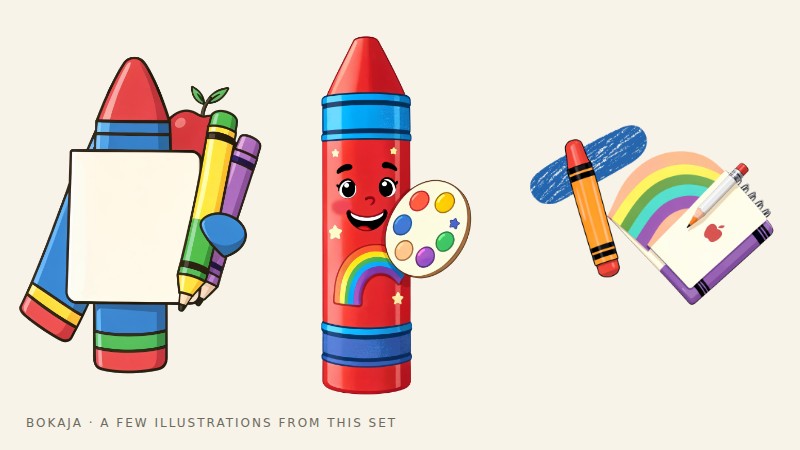
Rainbow Crayon Art Studio
Art-studio artwork for themed picture discussion.

Space Explorer Science Club
Science-club artwork for a space-themed discussion set.
Worked example: a picture-discussion card, not an ambiguous quiz

Create a 3 × 4-inch card for a themed vocabulary discussion. Use an illustration from the art-studio collection that you have inspected, then write a question that genuinely matches what is visible. Do not assume every file in a themed bundle represents a single isolated object or a scientifically precise diagram.
Place a 2 × 2-inch picture zone near the top, centered with half-inch side space. Beneath it, leave a 2.5 × 0.75-inch caption zone inside quarter-inch margins. Keep the bottom area free for handling. The whole card is 900 × 1200 pixels at a 300-PPI raster export size.
If the image contains several objects, “Name the tool in the center” may be clearer than “What is this?” If the target is a specific real-world object and the illustration is too stylized, replace it with a clear photograph or another suitable image. Decoration should not create a guessing game unrelated to the learning goal.
Make three trial cards before producing twenty. Check that each asks only one thing, that the answer is not accidentally printed on the same side, and that pictures are similar in visual scale. A tiny object surrounded by empty transparency should not be harder merely because its PNG canvas matches the other files.
For answer backs, number the cards discreetly and maintain a matching answer list. Print and flip a paper dummy to verify front/back alignment before using cardstock. If alignment is unreliable, keep a separate answer sheet for the adult or study partner.
When using science-themed artwork, distinguish an imaginative illustration from a factual diagram. Use the art to introduce a topic, then verify any scientific labels or claims from an appropriate educational source. The PNG bundle itself is not a curriculum or answer key.
Define what one card is meant to do
For a vocabulary set, the front might show one familiar object and the reverse its name. For a matching activity, you may want separate picture and word cards. For arithmetic, the front can show a problem and the back its checked answer.
Do not combine several tasks without a reason. A card with an animal, three unrelated words and a counting question may require the learner to guess what matters.
Write a list of six to ten items for the first version. Check spelling, terminology and answers against an appropriate source or curriculum before designing. Illustration is not evidence that a factual label is correct.
Choose images that communicate the intended concept
Use a clear image with a recognizable silhouette. For “apple,” one ordinary apple may be better than a busy market scene. For an animal name, avoid a highly stylized creature whose features could be confused with another species.
For scientific, historical or culturally specific material, verify both the image and the accompanying explanation. Decorative characters should not be presented as an authoritative visual reference.
Separate clues from answers
If the answer is on the reverse, use a paper dummy to test orientation. Number the fronts lightly in a proof version and match each reverse deliberately. A correct answer printed behind the wrong question is a production error that a pretty preview will not reveal.
Keep identifying marks subtle and consistent. If a picture-word matching game uses a different border color for every pair, the learner may match the colors rather than the intended content. That may be fine for some activities, but it should be a conscious choice.
When laying out backs for duplex printing, do not assume the reverse grid stays in the same left-to-right order. Mark one corner and use the numbered dummy to map each back to its front.
For single-sided cards, store an answer key separately if the task needs one. Check it against the final exported set, not an earlier draft.
Test the content with a small set
Print a few cards and use them in the intended way. Can the person see the picture clearly? Is the instruction understood? Are two answers equally plausible? Does the physical size make handling difficult?
Treat confusion as design feedback. You may need a clearer image, simpler wording or a different activity structure. Do not assume that failure to answer proves a lack of knowledge when the card itself is ambiguous.
Leave room for alternatives where appropriate. A picture may reasonably have more than one common name, especially across regions or languages.
Print for durability and easy replacement
Choose printer-compatible paper or card. If you laminate, check glare and thickness as well as durability. Rounded corners may be useful, but use suitable tools and supervision for the setting.
Keep a list of the card contents and a dated master file. Store each set with a clear label, perhaps using the approach in the classroom label guide.
If one card is lost or corrected, print only the replacement after confirming it matches the set. Before distributing digital files containing purchased artwork, read the current licence; permission for personal classroom use does not automatically authorize redistribution of source images or digital teaching products.
Your next step
Keep the first card set small enough to revise. Check ambiguous questions and mismatched backs before adding more cards, and preserve a clear answer record where the activity needs one.
Start with Rainbow Crayon Art Studio, or choose Space Explorer Science Club for the alternative theme described above. These collections supply PNG illustrations for your own layout; the project text and construction remain yours.