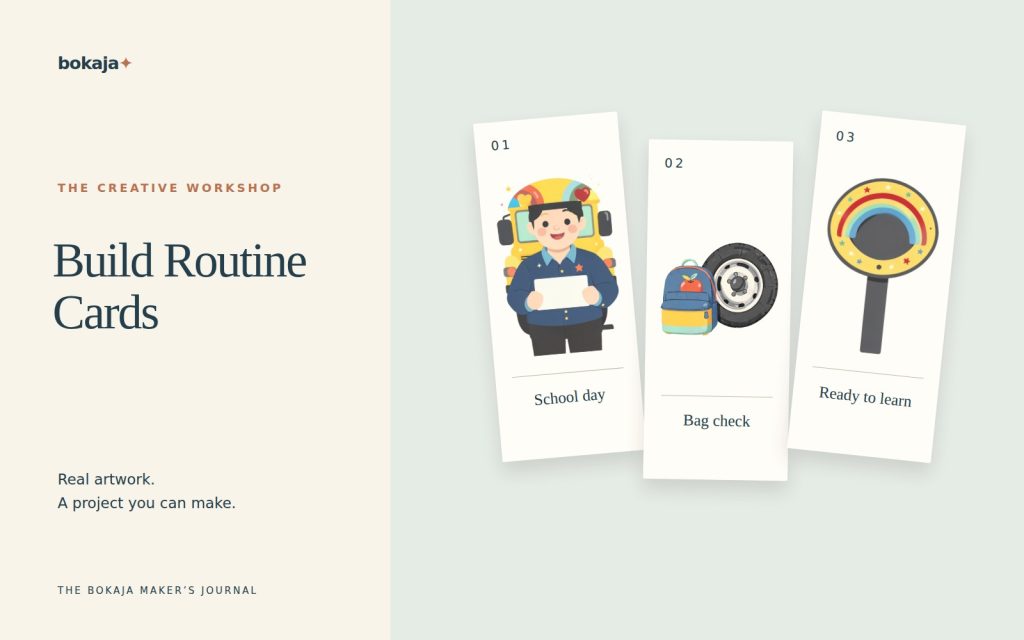
Visual routine cards work best when each card represents one clear action and the sequence reflects the real routine. Begin with a short, familiar process—not a full day of idealized behavior—and pair simple words with pictures the person using the cards understands.
Choose School Bus Morning Adventure for a routine heading, or Woodland Backpack Lunch Club for a school-day theme. Both are paid PNG artwork collections for layouts you design yourself; add your own text, shapes and measurements.
Make it with these Bokaja sets
Choose the style that fits your project. These are digital PNG artwork collections: add your own text and build the layout shown in this guide.

School Bus Morning Adventure
School-morning artwork for a routine heading.

Woodland Backpack Lunch Club
Backpack-and-lunch artwork for a school-day theme.
Worked example: three arrival cards that can change order
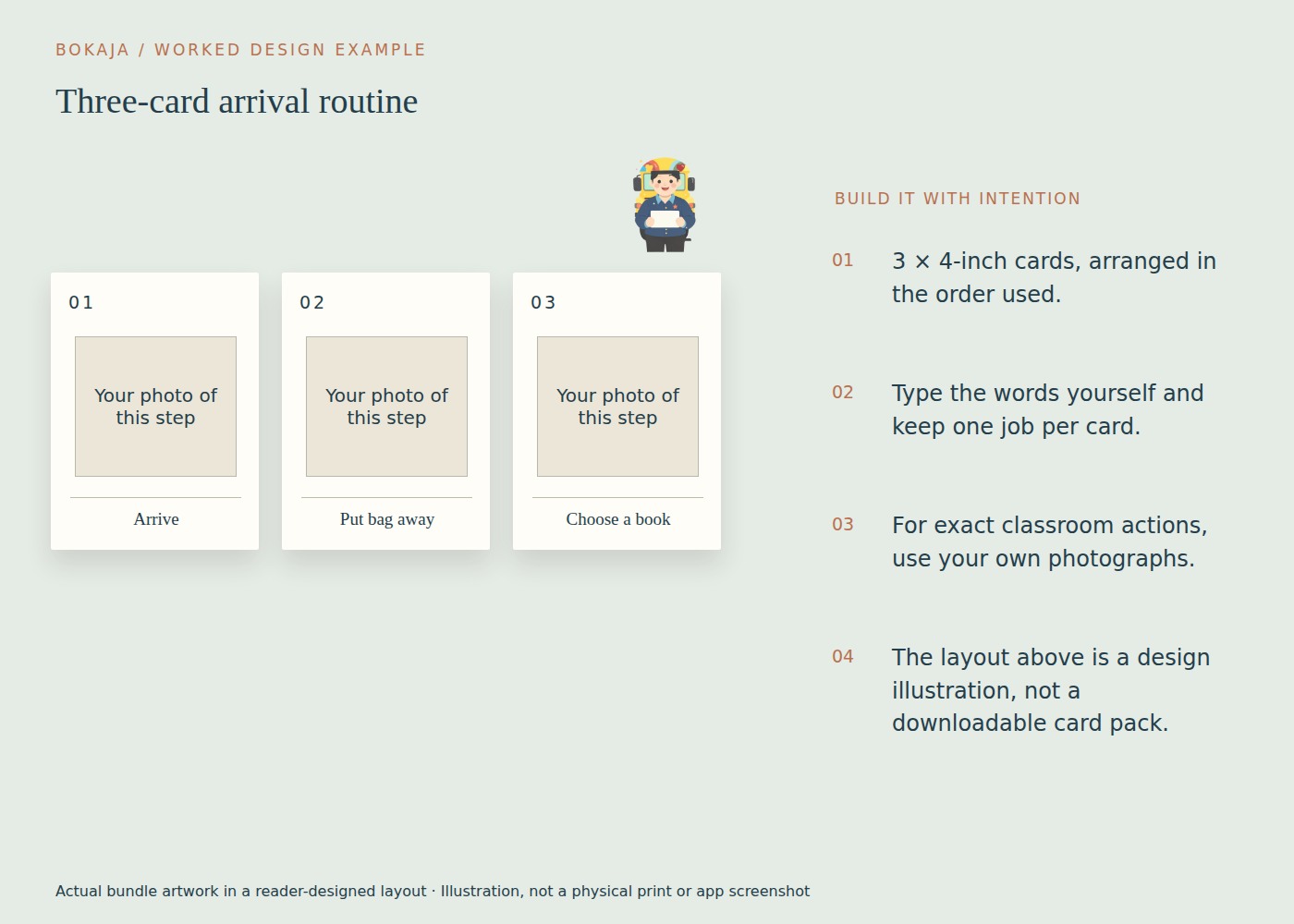
Start with three 3 × 4-inch cards: “Arrive,” “Put bag away” and “Choose a book.” These are an example sequence; use the actual steps and language familiar to the person using them.
Use school-morning artwork on a small heading or introductory card. For an action such as putting a bag in a particular cubby, your own clear photograph may communicate more accurately than a decorative school illustration. The collection supplies PNG art, not a complete set of action symbols.
Make a 3 × 4-inch master with a 0.25-inch safe margin. Reserve the upper 2.5 inches for the picture and the lower inch for the action phrase, with the remaining space used for separation. Begin around 20–24 points for a short phrase and check at the display distance. Keep the wording in the same position on every card.
Arrange the three cards left to right on a removable strip. Three 3-inch cards with two 0.25-inch gaps need 9.5 inches of display width. If the available wall space is narrower, use a vertical sequence rather than shrinking every card and making the words harder to see.
Introduce only this short routine first. Point to the current card, then move or turn it when that action is complete if that approach suits the user. Keep an extra blank card for an unexpected change, and explain the change in familiar language.
If someone consistently interprets a picture differently, replace the picture rather than repeating the instruction more loudly. If the sequence is too long, reduce the number of visible steps. The useful feedback is whether the cards make the next action clearer, not whether the display looks perfectly matched.
Choose one routine to represent
Start with something concrete, such as arriving at a classroom or preparing to leave home. Write the actual actions in order. An arrival sequence might be: hang coat, put bag away, wash hands, choose a book.
Check that each instruction is one action. “Get ready” may hide several tasks and mean different things to different people. Split it into visible steps where that helps, but avoid creating so many cards that the system becomes another obstacle.
Use the language normally spoken in the setting. A routine card should not require a lesson in unfamiliar vocabulary before it can help.
Decide which images are genuinely clear
You can use photographs, simple symbols or clipart. A photograph of the actual coat hook may be more recognizable than a generic illustrated wardrobe. A simple handwashing image may work well when the action is familiar.
Ask the intended user, where appropriate, what they think each picture means. If a decorative character is interpreted as “play” instead of “put the book away,” choose a clearer image. The prettiest illustration is not always the best instruction.
Build a sequence that can change
Arrange the cards on a strip or board with a clear reading direction. A removable system lets you reorder or omit steps when the real routine changes. Use suitable attachment materials and avoid small loose parts where they would be inappropriate.
Consider a simple “now” and “next” area if the full sequence is too much information. Another option is a separate finished area where completed cards can be moved. Choose the structure that helps the user, not the one that produces the most elaborate display.
Include a way to show a change rather than silently breaking the promised sequence. A plain change card or a brief explanation may be useful, depending on the setting.
Introduce the cards during a calm moment
Walk through the real routine with the cards nearby. Point to the current action, complete it, then move to the next. Keep the spoken wording consistent with the card where that supports understanding.
Observe what causes confusion. Perhaps the image is unclear, a step is missing, or the board is located too far from the action. Adjust the system rather than assuming the person is refusing to follow it.
Avoid turning the cards into a public compliance chart. A routine aid and a reward or punishment system are different things.
Keep personal information minimal
If cards include photographs or names, follow the setting’s consent and privacy rules. A publicly visible routine should not expose personal care information or sensitive details about a child.
Store editable files securely and keep a plain spare version where practical. Review the routine when the environment changes, such as a new classroom layout or a different arrival process.
For the mechanics of creating a consistent printed system, the classroom label guide covers measurement and readability. Use that same care here, while letting the user’s understanding—not the decoration—decide whether the cards are successful.
Your next step
Start with the three steps people actually need. Replace any confusing picture, shorten the visible sequence if necessary, and keep the cards easy to rearrange.
Start with School Bus Morning Adventure, or choose Woodland Backpack Lunch Club for the alternative theme described above. These collections supply PNG illustrations for your own layout; the project text and construction remain yours.
For commercial or shared deliverables, check the current artwork licence for the intended use.