A mummy museum activity works best when each printable has one clear job and every factual statement is checked before the room opens. Friendly artwork can connect the pieces, but teachers and activity leaders still control the clues, answers, route, age level, accessibility, and safety rules.
Build a controlled museum-style visual system
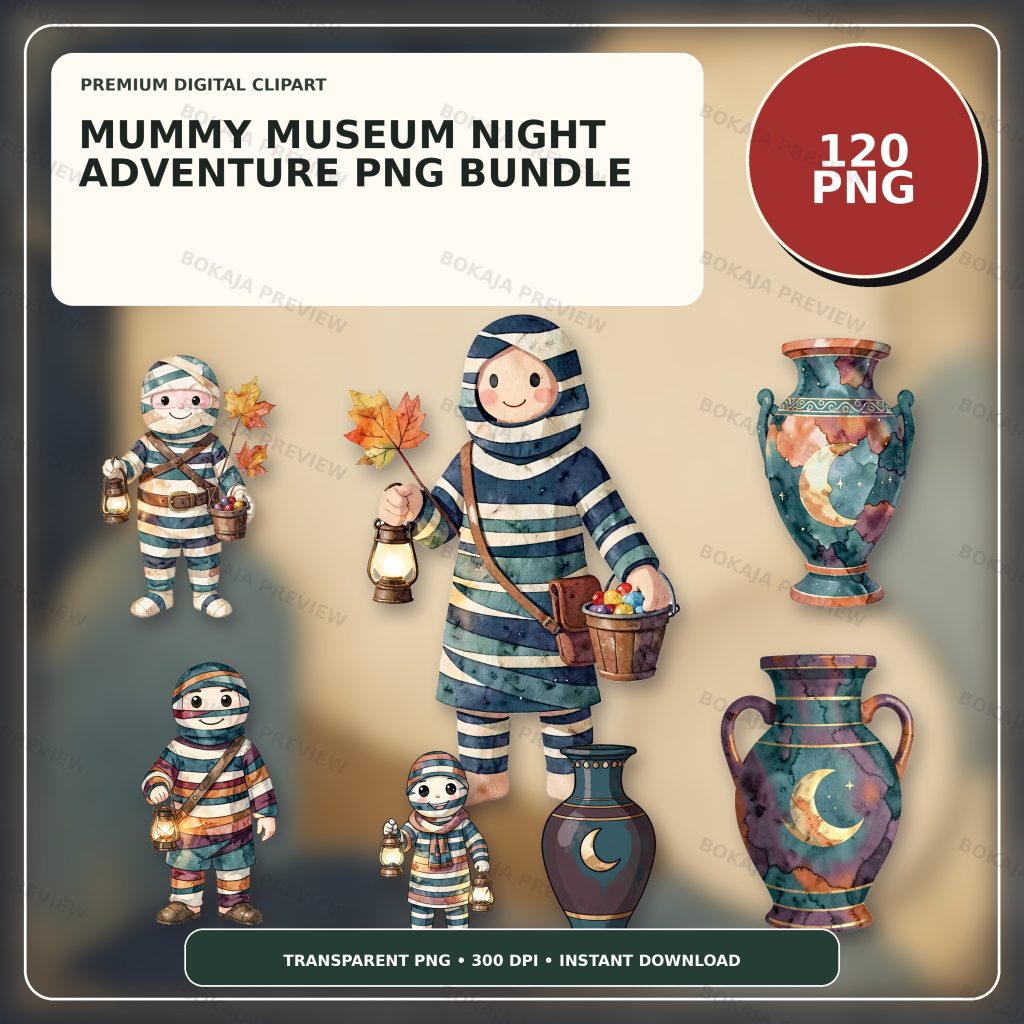
The Mummy Museum Night Adventure PNG Bundle is a live, purchasable digital product with 120 transparent PNG graphics at 3072 × 3072 px and 300 DPI metadata. Its original artwork centers on a friendly mummy explorer, a small lantern, and coordinated museum-style props without readable text, logos, known characters, or a complete exhibit scene.
These PNG files are decorative source material. They are not an editable scavenger-hunt template, history curriculum, archaeological reference, museum endorsement, safety plan, or accessibility assessment. Add every clue, answer, fact, number, direction, and name as live text in Canva or another layout tool.
Choose one mummy graphic for the activity heading, one lantern or museum prop for clue markers, and a simple number treatment for the route. A small visual vocabulary makes the set feel connected while leaving space for readable instructions.
Mummy museum printable matrix
| Printable | Practical job | Useful format | Adult review requirement |
|---|---|---|---|
| Clue card | Ask one question or direct one observation | Flat card | Verify wording, answer, reading level, and placement |
| Artifact label | Identify a pictured or classroom-made object | Tent or flat label | Separate facts from imaginative activity text |
| Gallery number | Make the route easy to follow | Large numbered marker | Check visibility and safe room flow |
| Observation sheet | Record answers, sketches, or findings | One-page worksheet | Provide an accessible response option |
| Award tag | Mark completion without ranking knowledge | Small tag or card | Avoid unsupported achievement claims |
| Recap card | Send home a short activity summary | Flat card | Keep names, facts, and follow-up links accurate |
The matrix is a planning aid, not a requirement to use every piece. A small room may need only numbered clue cards and one observation sheet. A library display may use artifact labels and a recap card without a timed route.
Write clues before adding artwork
Decide what participants should observe or do, then write one short instruction per card. A clue such as “Find the card with a lantern and write its number” is easier to check than a paragraph with several tasks.
Keep answers in a separate adult copy. Ask another responsible person to test whether each clue has one reasonable answer and whether the sequence works without verbal hints. If the activity includes historical statements, verify them through suitable educational or museum sources. Do not present fictional mummy-adventure details as archaeology.
Place the mummy image beside the clue, not behind it. Print one card at final size and read it from the expected distance. The Canva for beginners tutorial explains text layers, spacing, transparent PNG placement, and export checks.
Keep artifact labels honest
An artifact label can identify a classroom-made prop, a printed picture, or an imaginative story object. State which type it is. Wording such as “Activity prop inspired by museum displays” is clearer than suggesting that a craft item is ancient or authentic.
Separate verified facts from prompts. A small “Look closely” question can invite observation without making a historical claim. Avoid claims about cultures, burial practices, dates, translations, or discoveries unless the responsible adult has checked an appropriate source.
Do not encourage participants to touch real artifacts, display cases, electrical lights, or restricted areas. The printable cannot replace the rules of a school, library, museum, venue, or home.
Plan gallery numbers around safe movement
Large gallery numbers help participants follow the route without crowding around tiny clue cards. Put the number high enough to see but within the venue’s placement rules. Keep doorways, stairs, fire equipment, walkways, and accessibility routes clear.
Run a complete route test before the activity. Check whether two clues cause groups to collide, whether a marker is visible under normal lighting, and whether anyone must reach, crawl, or enter an unsuitable space. A Halloween theme does not require darkness; use ordinary safe lighting unless the venue has an approved alternative.
For clean edges and backgrounds, use the PNG transparency and quality tutorial before building a large batch.
Make observation sheets flexible
Offer more than one reasonable response method when the setting requires it: a short written answer, a checkbox, a simple sketch, or an adult-recorded response. Keep instructions literal and avoid relying only on color, decorative icons, or small details.
Do not collect unnecessary personal information. A first name, group name, or anonymous sheet may be enough, depending on the organization’s rules. Keep completed sheets out of public photographs unless the responsible adult has permission.
The classroom labels and teacher stickers tutorial gives practical guidance for matching label size, text load, and viewing distance to the real classroom job.
Mummy museum activity checklist
- ☐ Define the age group, setting, route, and supervision plan.
- ☐ Write every clue, answer, fact, number, and direction as editable text.
- ☐ Verify historical statements with suitable educational sources.
- ☐ Label fictional props and imaginative prompts honestly.
- ☐ Use one main mummy graphic and a small set of supporting props.
- ☐ Keep essential wording separate from decorative artwork.
- ☐ Provide a suitable response option for the participants.
- ☐ Use only the minimum personal information allowed.
- ☐ Keep walkways, doors, stairs, and safety equipment clear.
- ☐ Test the full route in normal lighting.
- ☐ Print one clue card, label, and worksheet at final size.
- ☐ Check text contrast and readability from the expected distance.
- ☐ Review the Bokaja digital product license before selling permitted finished physical items.
A soft product example
Product example: Use one friendly mummy explorer on the title card, a small lantern prop on each clue, and simple numbered markers for the route. The Mummy Museum Night Adventure PNG Bundle supplies a coordinated visual library while the organizer keeps every clue, fact, answer, name, and direction editable.
The product is digital; no physical cards, worksheets, museum props, or activity supplies are shipped. Its attached order-download PDF contains the download link for the ZIP package. Read Digital Downloads and Refunds for current access and support information.
Related Bokaja tutorials
- How to Make Classroom Labels and Teacher Stickers
- Roman History Classroom Printables
- How to Use Canva for Beginners
- How to Check PNG Transparency and Quality
- Halloween Party Printables Checklist
FAQ
Does the PNG bundle include editable scavenger-hunt templates?
No. It contains transparent PNG graphics. Build clue cards, labels, numbers, worksheets, tags, and recap cards in suitable layout software and keep all activity wording editable.
Can I describe a classroom-made prop as a real artifact?
No. Label props and imaginative story elements honestly. Verify any historical statement through an appropriate educational source and keep fiction clearly separate from fact.
Should a Halloween museum activity be run in the dark?
Not by default. Test the route under normal safe lighting and follow the venue’s rules. Decorative lantern artwork does not provide lighting or make a dark route safe.
Can I collect participant names on the observation sheet?
Use only the minimum information permitted by the family or organization. Consider a first name, group label, or anonymous sheet when that meets the real activity need.
Can I sell finished activity cards made with the graphics?
Review the digital product license first. Permitted finished physical items are different from reselling, sharing, extracting, uploading, or repackaging the original PNG or ZIP files.