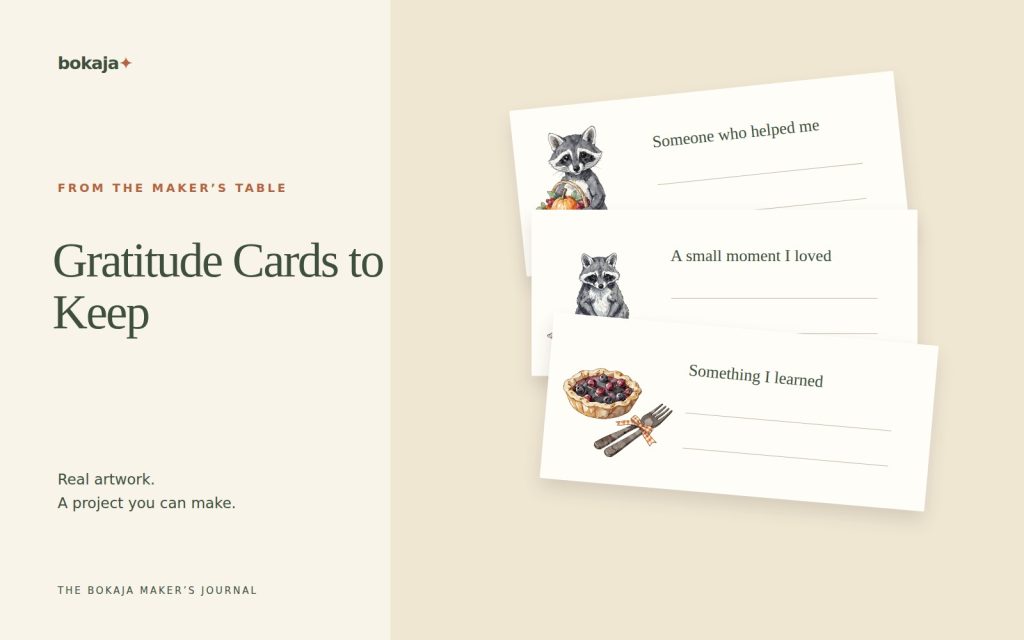
Thanksgiving gratitude cards can offer a quiet way for guests to write something they appreciate, without requiring a speech or a public display. Make the prompts optional, leave generous writing space and choose a collection method that fits the gathering.
Choose Raccoon Thanksgiving Gratitude Picnic for a reflection card, or Kawaii Thanksgiving Table Setting Club for a dinner-table variation. Both are paid PNG artwork collections for layouts you design yourself; add your own text, shapes and measurements.
Make it with these Bokaja sets
Choose the style that fits your project. These are digital PNG artwork collections: add your own text and build the layout shown in this guide.
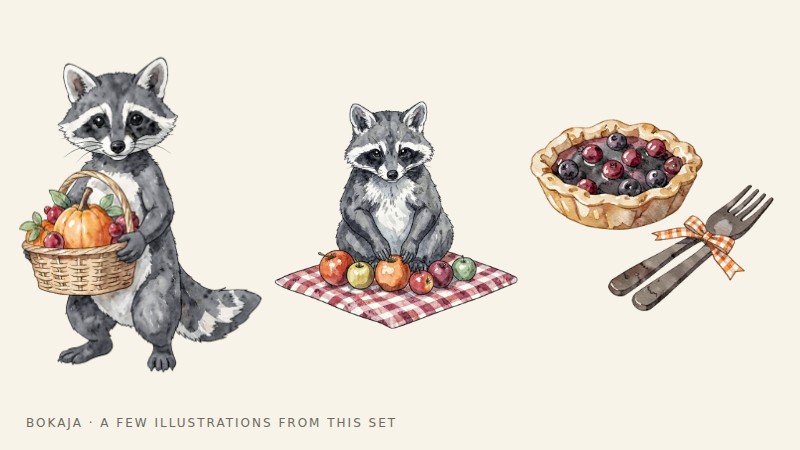
Raccoon Thanksgiving Gratitude Picnic
Gratitude picnic artwork for a reflection card.
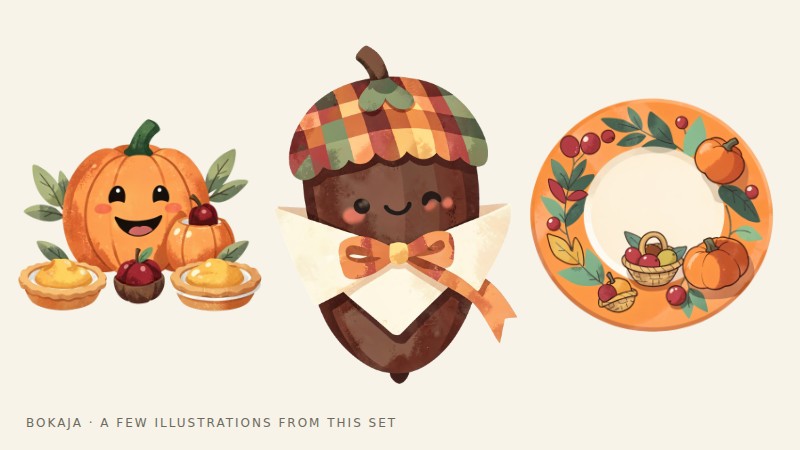
Kawaii Thanksgiving Table Setting Club
Table-setting artwork for a dinner-table variation.
Worked example: a 4 × 6-inch card with one honest prompt
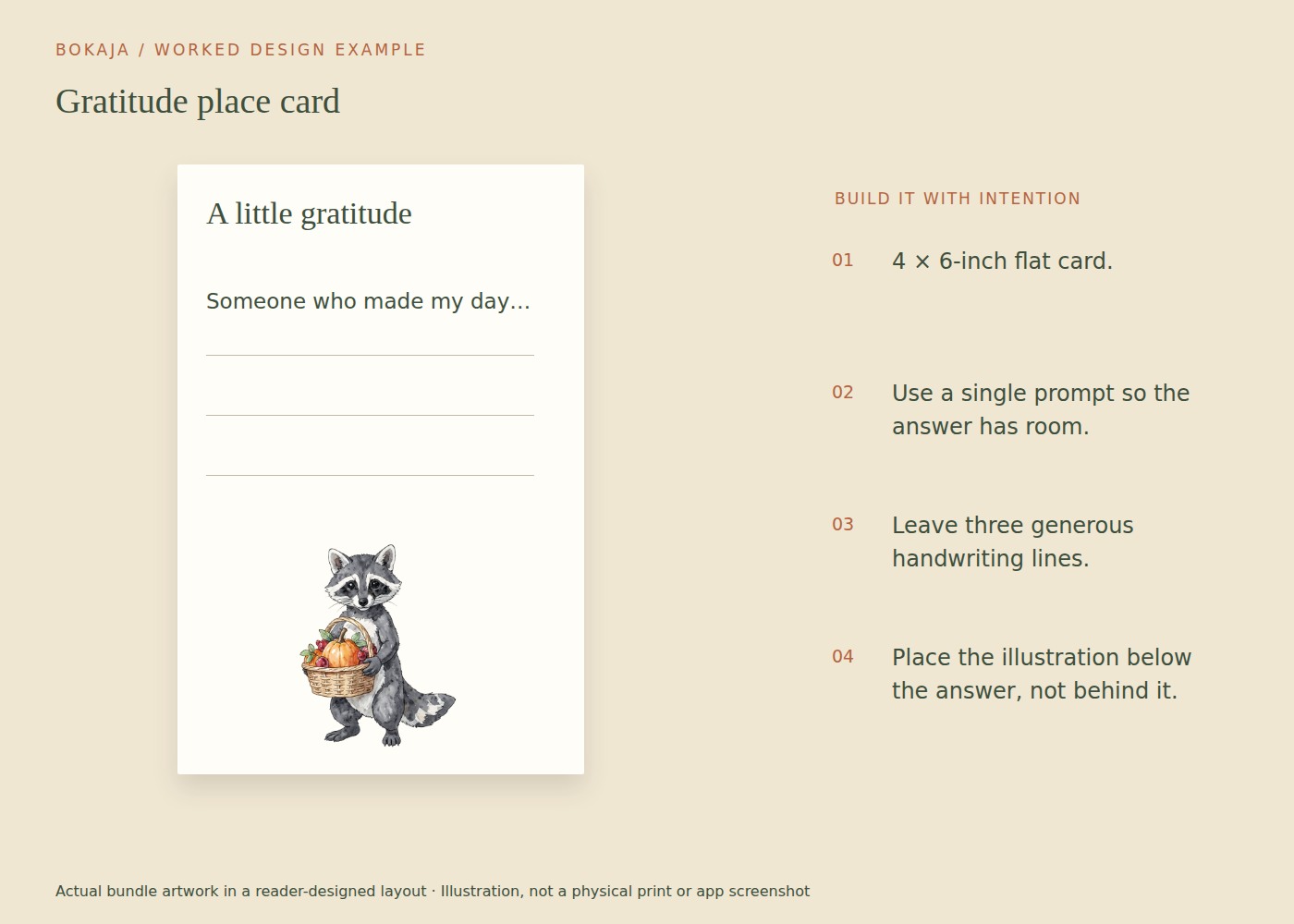
Use a 4 × 6-inch portrait card and one small illustration from the gratitude-picnic collection. Keep the response space larger than the decorative area. The table-setting collection is a coordinated alternative if the cards will sit at individual places.
Place guides 0.375 inch inside each edge. This leaves a 3.25 × 5.25-inch interior. Give the heading 0.75 inch and the prompt about 0.75 inch, then reserve at least 2.5 inches for handwriting. Put a 0.75-inch artwork accent near the bottom or heading, outside the writing lines.
Try a single prompt: “One small thing that made this year easier was…” It allows an ordinary answer and does not demand a major life story. Add “Write, draw or leave blank” in a modest but readable line if that suits the gathering. Participation should not depend on giving a public explanation.
For three handwriting lines, leave about 0.5 inch between baselines and enough blank space around them. Print one proof and write a realistic two-sentence answer. If the response feels cramped, remove a decorative element or shorten the prompt instead of shrinking the writing space.
On Letter paper, two 4-inch-wide cards with a 0.25-inch gap use 8.25 inches, leaving only 0.125 inch at each side if centered. That may fall outside a home printer’s usable width. Do not assume a two-up portrait arrangement is practical; rotate, change the layout, use larger stock or print one per page according to the actual printer limits.
Offer a collection envelope or let guests keep their cards. If you plan a shared display, say so before people write. The layout can be saved for next year without keeping or publishing anyone’s personal response.
Decide how the cards will be used
Choose between cards placed at each seat, a small writing station or cards offered near the end of the meal. Think about whether guests will keep them, give them to someone or place them in a shared container.
Tell guests what will happen to the completed cards. A private note should not unexpectedly become a public reading activity or a photograph for social media.
Allow people to pass, draw or write something brief. Gratitude should not become a test of optimism, especially when a guest is having a difficult season.
Choose prompts that leave room for real answers
Use one prompt per card, or offer a small choice. Examples include:
- “A small thing that helped me recently…”
- “Someone I would like to thank…”
- “A moment I want to remember…”
- “Something I hope to make time for…”
Avoid wording that assumes everyone has the same family structure, health, finances or experience of the holiday. A general appreciation prompt can be more welcoming than a demand to name a perfect family memory.
You can also include a completely blank card for a drawing or personal message. Not every contribution needs to follow a printed sentence starter.
Choose artwork without inventing a historical story
Treat the design as a contemporary gathering activity. Do not add an oversimplified historical narrative or cultural imagery you have not researched and do not have a good reason to use.
If the gathering includes a discussion of the holiday’s history, use appropriate, well-sourced material separately. Decorative clipart is not a substitute for that work.
Print for comfortable handwriting
Choose paper that accepts the pens or pencils available at the table. Test the actual combination, especially if using coated card. A surface that prints vividly may smear when someone writes on it.
Use readable type and enough contrast for ordinary dining-room light. A pale script heading may look elegant on screen but be difficult for some guests to read.
Print one card at the final scale and write a realistic response. If a normal sentence runs out of space immediately, enlarge the writing area or shorten the prompt before producing the set.
Set up the activity simply
Provide pens, a clear instruction and a place for completed cards if they will be collected. A small sign can say: “Write or draw if you wish. Keep your card, give it to someone, or place it in the bowl for the host.” Adjust the wording to the actual plan.
If some cards will be read aloud, make that choice explicit before writing begins. Ask permission before sharing a named message or photographing completed cards.
Keep the activity brief enough that conversation can continue naturally. You do not need to fill every moment of the gathering with a formal program.
Save the layout, respect the messages
Keep the blank editable master for future use, but handle completed cards according to the guests’ expectations. A personal message should not become a reusable marketing example without consent.
For general layout mechanics, see the Canva PNG guide. Review the current artwork licence before selling printed cards or sharing digital files. The finished result should leave more space for the guests’ words than for the maker’s decoration.
Your next step
Save the blank card master, not an assumption that completed responses may be shared. Let guests decide whether their words are kept, given privately or included in a display.
Start with Raccoon Thanksgiving Gratitude Picnic, or choose Kawaii Thanksgiving Table Setting Club for the alternative theme described above. These collections supply PNG illustrations for your own layout; the project text and construction remain yours.